Showing posts with label consumerism. Show all posts

Friday, January 05, 2007

The Zavelogue's Final Entry

I had a lot of mixed emotions upon returning to the U.S. In this final entry from the India Zavelogue I explain some of the feelings and the origins of The Curious Stall:

It's been more than a month since my last entry. Although we've been busy, the real excuse for failing to bring the Zavelogue to the type of dignified closing that I think it deserves has to do with all of the very mixed emotions I have been having.

We were in Seattle last week for my cousin's wedding. My mother rented a house for the week, and we stayed there with her and my sister's family. It was the first time in a long while, probably ever, that we all got to spend so much time together. I had a good time, but I guess outwardly I seemed troubled. My sister thought I seemed very depressed and suggested I try medication. Her dismay with my behavior caused me to think about what I was feeling.

I think I can narrow down my emotions to two related factors: (1) our re-assimilation happened too quickly and left me without an opportunity to transition between what we experienced in India and what we were returning to in the U.S.; (2) in the six weeks since we've been back, few people with whom we've interacted have expressed any real genuine interest in what our experience was like.

First, here are some pictures to illustrate the three types of environments through which we transitioned:


India: Lots of cows and blazing hot

Switzerland: Lake Geneva and the Alps

San Francisco: Fog and the Golden Gate Bridge

Re-assimilation

I can't say what would have been the most appropriate way to make the transition back to life in the U.S. I'm pretty sure, though, that hopping from India to a week in Switzerland was not the best way. India ranks near the bottom in most measures of GDP, health, and literacy. Switzerland ranks near the top. Perhaps the best approach would have been to return directly to our home. We certainly enjoyed getting to see our respective families in Maryland and Seattle, but those weeks were tough knowing that the journey was over on one hand, but also that we were not yet really home.

Then there was the--for lack of a better word I'll risk sounding cliche--culture shock upon returning to the U.S. This was a little different than the shock of jumping from India to Switzerland. Switzerland is a wealthy, and therefore expensive, place. Switzerland is all about quality of life. But the wealth of the U.S. manifests itself differently. In the U.S., we know we are a wealthy society because of the amount of stuff we consume, not because we have a high quality of life. In fact, despite our levels of consumption, we do not have a high quality of life. For example, despite our wealth, Americans tend to be less healthy, on average, than our counterparts in other parts of the developed world.

My point is that American consumerism made the transition tough. For the six months we were in India, I felt virtually no compulsion to consume. That's not to say that I didn't consume. It goes without saying that to exist one must consume. In fact, we consumed more than the basics. And while in India we certainly consumed far more than the average Indian, even if you exclude all the gifts and items we bought to bring back with us.

What I mean when I say I felt no compulsion to consume is that I was not exposed to the types of goods, nor advertisements for such goods, that gave me a "I'd really like to have that" feeling. As much as I'm a critic of American consumerism, I am implicated just the same. That's precisely my point. Living in the U.S. without being sucked into the practice of justifying extravagant purchases as somehow "essential needs" and not whimsical "wants" requires a herculean effort.

For six months I never visited a shopping website. And though we spent a fair amount of time in shopping malls, where the only decent children's play areas could be found, I never bought anything for myself except a book or two. Yet within two days of returning, even without having watched a minute of television, I found myself wanting. Do I need a new computer? Absolutely not. But Apple has some really nice new iMacs and laptops. My consumer mind begins trying to convince my rational mind that I do need a new computer. After all, my PowerBook got pretty banged up while in India and the nearly full hard drive seems to slow down basic tasks.

I don't recall having gone through that sort of internal dialogue while in India. Yet it's precisely such a dialogue, and one in which the consumer mind wins the debate, that is crucial to a thriving consumer society.

Interacting with others
Returning has also been difficult because in some unidentifiable way I feel like the experience in India has changed me, and yet I don't know how to communicate this change to others, nor do others ask me anything other than superficial questions about the experience. I write some of this off to the fact that I explained in fairly great detail what the experience was like right here in the Zavelogue. I can imagine that regular readers don't have a lot of questions about what the experience was like. That's probably why, in some cases, people we've seen for the first time in six months greet us as if we've just returned from a weekend trip to Santa Barbara. Part of what I am trying to explain here is the strangeness of feeling like we just slipped right back into our lives without missing a beat. One source of my anomie comes from not wanting to feel that way.

As for interacting with strangers, it's as if I want there to be a big sign over my head saying "Hey! I've been in India the last six months!" It's not that I want any special attention. I would like for people to know that the experience changed me, but this information may be irrelevant to a stranger. It's more that I feel like I have some insights that are interesting, if not also helpful for understanding some of the global changes happening as a result of globalization.

This is why I have to get going on my book. But I also want to get ideas out there right away, which is why I am closing down the Zavelogue and launching a new blog called The Curious Stall. Postings will be much less frequent, less personal, and a tad bit more intellectual. Read the first entry to find out why it is called The Curious Stall.

The Curious Stall will be a way, in the short run, for me to continue working out some of the feelings I discussed above. But I also want it to be a place where a much wider audience engages ideas about the changes through which India as a nation is going, and what these changes mean for its people, other people around the world, and our understanding of ourselves.

With that, I promise not to recycle any more content from the Zavelogue. I've got a pile of topics I want to write about in The Curious Stall. From here on out, expect more original content, and hopefully, more frequent content.

Technorati tags: , ,

Thursday, January 04, 2007

Globus, Part II

In my previous post I discussed Globus and its India-inspired shopping theme. Here's another post from a few days later after I'd reflected on Globus's "Mumbai/Bombay" marketing campaign a bit more:

The whole idea of selling "India" bothered me, and I've had a little more time to figure out what it is that is so bothersome.

We happened to discover another Globus in Lausanne, so I picked up a copy of the Globus catalog. Actually, the catalog is more like a lifestyle magazine cum catalog. Amidst the product images and descriptions, one finds articles about Mumbai, for example, and recipes for Indian dishes. Following a recipe for Butter Chicken, there might be a picture of bowls for sale. Only these are not your typical department store bowls. Keeping with the Globus Mumbai/Bombay theme, the bowls for sale are made of banana leaves pressed into the shape of a bowl and then dried. Restaurants in India often provide these bowls to take away customers, and some street vendors serve up their fare in such bowls. Of course, Globus offers the chic urbanite from Europe the ability to purchase these bowls and then in the comfort of their own home eat from them the food prepared following the recipe Globus provides for "authentic" Indian dishes.

I bring this up again, and in more detail, because since returning to the U.S. we've noticed several other instances of "brand India" for sale. At least two of the catalogs Marion has come across here at my in-laws have whole lines of India-inspired clothing for sale. All of a sudden it seems that it's hip to be Indian. It's possible that it's been hip to be Indian for some time, and that we never noticed. Or perhaps we've become hyperaware of all things Indian outside of India now that we're back from India ourselves.

Either way, the fact that it's hip to be Indian irks me. Appreciating "brand India" is very different than having any sincere appreciation for the country, its cultures, or its problems. So when western consumers turn India into a lifestyle, I find it troubling on a number of levels. First of all, its not terribly hip for Indians to be Indian, at least not in the U.S. While in India, we talked to at least one Indian who left the U.S. after 17 years because he had found it inhospitable in the post-September 11 culture of fear.

Why would it have become inhospitable for him? Because the color of his skin leads Americans to the presumption that he is either (a) Muslim, or (b) from the Middle East, and therefore a threat. For an Indian in the U.S., in other words, there is nothing hip about having dark skin. Even within India it's not hip to have dark skin. Advertisements for sunscreen urge people to use sunscreen not to protect their skin from the sun's harmful UV rays, but rather to keep their skin light in color. India is still very much influenced by the caste system, and the upper castes tend to have lighter skin.

So I am bothered by the fact that "being Indian" is really only hip if you're not Indian. But more bothersome is the fact that, most likely, none of the more than half a billion Indians living in poverty are benefiting from the commodification of their lifestyles. I guess it's too bad that they never patented their traditional fashions, their stainless steel bowls, and their terra cotta chai cups, all of which are now for sale at Globus for sums 10-100 times what the same items fetch in India. Take the hip hop industry in the United States, at least here you have a model for returning a bit of wealth to a traditionally exploited and oppressed segment of the population through the commodification of its culture.

Now here's the kicker...Globus was founded in 1907 and is one of Switzerland's oldest retail stores. When I discovered this, I thought a little more deeply about the way in which Globus is exploiting India. The west, after all, has been doing this long before anyone ever heard of Globus. World's Fairs at the end of the 19th century were a way to expose people to the exotic ways and wares of other cultures (as well as to promote the glory of the host country). The British made the practice a science in the form of the British Museum, where everything from Egyptian mummies to African pygmies were put on display for the curious Brits to see.

I guess Globus prompted in me the question of where the line should be drawn between spreading cultural awareness and capitalizing on a culture's transient popularity in wealthy fashion markets.


Technorati tags: , ,

India Redux in Geneva

I've been so delinquent lately in maintaining The Curious Stall that I am resorting to re-posting some of the entries that appeared in the India Zavelogue, the travelogue where I blogged during the six months my family and I lived and traveled in India. I think the entries that I'm plagiarizing from myself are very much in the spirit of the types of things I've been writing about here at The Curious Stall. So read on, and if you're interested in more of the personal account of the experience we had in India, follow the links to the India Zavelogue where there are well over 100 entries.

The first entry I'm borrowing from the Zavelogue comes from an experience we had in Geneva, Switzerland, the first place we stopped after leaving India. Enjoy...

There's a department store in Geneva called Globus (warning: French and German only). As far as we can tell, the store's gimmick is that its displays and decorations reflect a different city or region of the world every month or so. We walked into Globus and for a second thought we were back in India. "Mumbai/Bombay" was the theme for May and June, 2006.

Globus in Lausanne, Switzerland (photo from Globus website)
OK, that's not true at all. We didn't mistake Globus for India for a second. In fact, what was surprising to us was the way that "India" had been branded. The idea of India--its cultural uniqueness--was what was being sold at Globus. But it was, of course, a completely sanitized version of India. One section of the store had an autorickshaw on display. It looked like an authentic rickshaw, probably shipped from India (or more likely, from the Piaggio factory in Italy where, except for Bajaj rickshaws, India's rickshaws are made). The rickshaw had some actual dirt on it, but was for the most part stripped of the filth typically covering an Indian rickshaw (except for Mohammed, our driver in Ahmedabad, who kept his rickshaw very clean).

In other parts of the store tiffins, the little circular "lunch boxes" that Indians use, were used in displays. Water jugs, turbans, ceramic cups and other little touches were also used to give an "Indian" feel. But make no mistake, there was nothing Indian feeling about Globus. Elements of Indian culture and society had been co-opted by the Globus design team to sell consumers high-end products, many of which one would have great difficulty finding in India. For example, by purchasing a simple-looking pair of leather sandals, for around 100 euros, one can imbibe the spirit of India without actually being there.

It was hard to imagine what the average (i.e., poor) Indian would think entering Globus in all its branded India glory. My guess is that a dweller of Dharavi, India's and Asia's largest slum, would have walked into the very same Globus we visited and said, "Hmm, my life is for sale here. Why would people want to buy my life?" Yes, indeed, why would a wealthy European want to buy the trappings of Indian culture?

I'll write more about Globus, and more specifically the commodification of Indianness, in the next entry.


Technorati tags: , ,

Sunday, December 17, 2006

Consumerism and dowry

I recently received an email from a reader of the "Consumerism in India: A Faustian Bargain?" series I posted back in August and September. For a refresher, you can click here to go to the first entry in the five-part series, or to view all my posts tagged "consumerism," click here.

Nicoletta, an Italian woman beginning a PhD program in Indology, wrote to ask what I knew about the influence modern consumerism in Indian society is having on the practice of dowry:
Many scholars and commentators have stressed a correlation between the increase in dowry demands (and its murderous manifestation) and a more consumer oriented society in India, especially among middle urban classes. Is for this reason that the research project I'm about to start will be an attempt to take a critical look at global consumerism in India, linking it to the practice of dowry. What I want to try is to start reconstructing the "social life of things" belonging to the dowry list on a intergenerational bases ... I was wondering whether you know single scholars and research centres in India dealing with the issue of dowry from my same point of view and which can assist me in the field phase of my research project.
Here's an excerpt, with some modification, from my response:
Your research idea sounds very interesting.

You might be interested in checking out the following blog entry at POV, it offers a brief summary of a recent book by Vrinda Nabar called Caste as Woman.

As per your specific questions, unfortunately I'm not an expert in the area of your interest, so my suggestions are limited.

In terms of the concept of the "social life of things," I would recommend you read a book by Mihaly Csikszentmihalyi and Eugene Halton called The Meaning of Things: Domestic Symbols and the Self. It's now about 25 years old, but I think remains one of the best analyses of the way that we attach symbolic meaning to everyday material objects in our lives. It's focus is on the U.S., but theoretically I think it might be useful for you.

With respect to your research, I'd be interested in hearing more about the approach you plan to take. It sounds like you might, quite litrerally, inventory the items included in dowries across generations in particular families. Presumably you would, as well, compare changes in the make-up of dowries across families in order to understand how consumerism is more or less influencing the dowry practice in different castes, for example.

I would be very interested to see the extent to which modern consumer goods, especially those valued largely for their labels, are becoming a standard part of dowries.
I went on to tell Nicoletta that I would post an entry about her research interests, in the hopes that a reader or two might have some suggestions for her. I know there are many outstanding organizations in India working on reforming the practice of dowry. If you are a reader who has any familiarity with such organizations, please leave information about them in a comment to this post. I will make sure the information gets back to Nicoletta.

More importantly, I'd like to hear some discussion on this topic. Sociologically, the melding together of traditional practices with contemporary ones is one of the most fascinating aspects of globalization and the spread of consumerism. My guess is that there are parallel changes happening within the dowry practice. On one hand, among some segments of the population, the dowry practice is slowly eroding. But on the other hand, I suspect that Nicoletta is on to something--the way many Indians are embracing consumerism must be intensifying dowry practices, both with respect to the quantity and make-up of the goods constituting a dowry.

I hope some readers, more familiar than me on this topic, will share some thoughts.

Technorati tags: , ,

Wednesday, September 13, 2006

Epilogue to the Consumerism in India Series

An article (login may be required) in today's New York Times provides the perfect epilogue to the now-concluded five-part series "Consumerism in India: A Faustian Bargain?" (Parts 1, 2, 3, 4, 5) In the series, I focused more on the psychological and social consequences of life in a consumer society. I also touched on the impacts on the lives of people implicated in the global chain of production and consumption. What I did not mention were diseases of affluence. Adult onset diabetes, now more widely known as Type 2 diabetes, is a perfect example:

In its hushed but unrelenting manner, Type 2 diabetes is engulfing India, swallowing up the legs and jewels of those comfortable enough to put on weight in a country better known for famine. Here, juxtaposed alongside the stick-thin poverty, the malaria and the AIDS, the number of diabetics now totals around 35 million, and counting.

The future looks only more ominous as India hurtles into the present, modernizing and urbanizing at blinding speed. Even more of its 1.1 billion people seem destined to become heavier and more vulnerable to Type 2 diabetes, a disease of high blood sugar brought on by obesity, inactivity and genes, often culminating in blindness, amputations and heart failure. In 20 years, projections are that there may be a staggering 75 million Indian diabetics.

I don't have much to say about the article at this point. I just wanted to make sure that readers are aware of it and that the issue gets some attention in the blogosphere. The only concern I will raise is what I imagine is the dominant attitude towards this problem. The attitude, characterized by Dr. A. Ramachandran, the managing director of the M.V. Hospital for Diabetes, in Chennai, is captured in the following quote from the article:

“Diabetes unfortunately is the price you pay for progress."

I realize that Dr. Ramachandran does not represent all Indians. But if this is how India responds to the problems of consumerism and affluence, some of my predictions in the "Consumerism in India" series about the future of India looking more and more like troubled western consumer societies are already coming true. Perhaps for India, the future is now.

Technorati tags: , , ,

Tuesday, September 12, 2006

Consumerism in India: A Faustian Bargain? (Part 5 of 5)

The Bigger Picture

Before bringing this series to a close, I want to place India’s move towards a consumer society in a larger framework. India, after all, represents a microcosm of the larger globalizing world. For within India exists the same tension permeating global society. The tension is between those individuals who have benefited from economic liberalization and who have become full-fledged citizens in the consumer society, and those individuals who struggle to provide for themselves and their families the basic essentials for survival, reaping little or no benefits of economic liberalization or the consumer society.

Let me elaborate on this tension by examining the way in which the current global arrangement allows citizens of the developed world to deny any personal responsibility for the consequences of consumption. In fact, not only do we deny any responsibility for the ways in which our consumer lifestyles lead to global problems like climate change or local problems like sick workers or communities contaminated by industrial wastes, we go so far as to propose that the solution to the problems of the developing world is even more consumerism.

To function, a consumer society depends on consumer blindness to the broader social, cultural, and environmental consequences of our marketplace decisions. American-style consumerism has done very well at keeping the American consumer from understanding the nature of the damage done by the production and distribution of our cheap goods. As a result, Americans think it makes perfect sense that we have a right to our big SUVs, to our cheap disposable goods, and to our cheap out-of-season produce shipped to us from around the world. We work hard, so the argument goes, these things are available to us in the marketplace, and therefore we have a right to spend our hard-earned money on them if we so desire.

photo by flickr member "jennie"

How do Americans fail to make connections between our consumer choices and matters of social justice for people elsewhere around the world? After all, we make connections between heroine or bootlegged DVDs and terrorism, and define it as our moral duty to abstain from purchasing any products that might aid terrorist activities. We also make the determination for others that the production and consumption of pornography, tobacco, alcohol, and drugs, can be dangerous for certain members of society. So we regulate the production and distribution of such goods and services. Yet we don't regulate our own companies when they operate overseas in ways that would clearly be in violation of U.S. standards, and we certainly don’t regulate our own consumer behavior even though our decisions in the marketplace may perpetuate global systems of injustice.

The U.S. grew economically wealthy as a country during the last half of the 19th and the first half of the 20th century. This growth was a result of visionary leaders, innovative entrepreneurs, and hard-working immigrants who came in search of the American dream. Many of them achieved it. But in the mid-20th century, when it began to become apparent that some of our growth was made possible through various forms of internal exploitation (e.g. child labor, the labor of illegal immigrants, and other forms of exploitation of labor, as well as through exploitation of the environment in the form of pollution for which corporations did not have to pay), we passed laws to put constraints on these forms of exploitation. Corporations determined that they could escape these constraints by moving to other parts of the world where, because of range of factors, regulations were either non-existent or unenforced and industry in any form was welcomed.

Today, these same corporations are able to provide Americans, as well as other developed societies, with the cheap goods to which we believe we have a right. At one time, Americans could make purchases in the marketplace and be somewhat assured—because most everything we purchased was made in the U.S. and therefore met American labor, environmental, and human rights standards—that our purchases were not harming people or the environments on which people depend for their livelihood. Today we live in a global marketplace and therefore do not have the luxury of being so presumptuous.

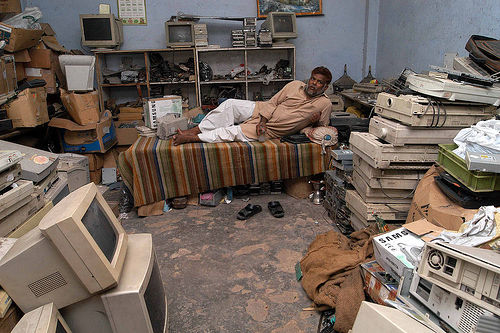
But the successful consumer society buffers its members from the material universe of consumerism. Consumers cannot be permitted to know the true costs of their consumer lifestyles for fear they would either reduce their consumption levels or demand goods manufactured to certain basic social and environmental standards. This has largely worked in the U.S. since we have been able to off-shore most of the uglier aspects of the material universe of consumerism. India is one among many of the destinations. Whether collection of our obsolete and hazardous electronic waste, destruction of the retired ships we used to transport our cheap goods, or exploitation of cheap labor to manufacture textiles, semiconductors, or other goods, Americans are largely isolated from the hazards involved in the production, distribution and disposal of our consumer goods.

Living amidst eWaste: photo by flickr member "Greenpeace India"

Can India similarly protect its privileged consumers from the harsh realities of producing, distributing, and disposing of cheap consumer goods? After all, not only are there are few places left to “off-shore” the ugly aspects of the material universe of consumerism, but most of the ugly aspects already coexist with among India’s malls, gated communities, and other trappings of developed world consumerism. If through the process of globalization Americans have managed to export not only our hazardous waste and dangerous jobs, but also our belief that in a consumer anyone who works hard has the opportunity to enjoy the fruits of her or his labor in the consumer marketplace, then maybe India can shield its full-fledged consumers from the knowledge that their consumerism sustains domestic and global inequality.

But perhaps Indians will find other motives for rejecting, or at least accepting on their own terms, American-style consumerism. Indians have always maintained a healthy suspicion of U.S. motives with respect to their country. Now should be no time to relinquish this skepticism. It may seem as if Americans want Indians, who make up a huge untapped market, to join us in our consumer lifestyles. But I doubt Americans wish for Indians to join us because we have some deep sense of compassion and justice that leads us to believe that Indians must be given access to the same quality of life as us. If we were motivated by a deep sense of compassion and justice, we’d call into question our own lifestyles, which are only sustainable to the extent that others around the world are denied some of the basic comforts—like clean drinking water—that we take for granted. Americans, or more specifically the American government, first and foremost support India’s transition to a consumer society because it is good for the American economy, not because of any concern for India’s millions of citizens living in poverty.

India: An Improvement on the Consumer Society or a Faustian Bargain?

With all this criticism, readers might be asking whether I have a solution. Suggesting an alternative approach to economic development has not been the purpose of this series, though I think a reasonable approach would combine a mix of large-scale development projects that are sensitive to local people and small-scale development projects that protect and nurture the very crafts, skills, and traditions that make India what it is today. Rather, my aim has been to point out that even if consumerism is the path India pursues, Indians should be asking some difficult questions. How will consumerism change India and Indians? Can India tailor its own uniquely Indian consumer society that avoids the pitfalls of western-style consumerism? If India embraces a patently western-style consumer society model, will it have "sold its soul" as the legendary Faust is purported to have done?

Indians don't seem to be asking these questions. Instead, what I hear many educated Indians say is this: “Sure India is changing rapidly and we have no idea what it will be like in 20 years. But we have no option, this is the only hope we have of taking care of our people.” Even if consumerism is the approach that India follows, which already seems to be the case, Indians ought to enter into it with a critical perspective that may help them avoid some of the negative outcomes, like those discussed in this series, that unquestioning American consumers now experience.

Tuesday, September 05, 2006

Consumerism in India: A Faustian Bargain? (Part 4 of 5)

In the last installment of the “Consumerism in India: A Faustian Bargain?” series, I concluded by suggesting that consumer capitalism, in order to maintain a constantly increasing rate of growth, reshapes or even breaks down existing cultural traditions. Without cultural traditions, from which people derive a sense of belonging, a sense of being loved, and ultimately their very sense of who they are, people turn to the consumer commodities of the marketplace to fulfill these needs.

Cultural change happens all the time. Historically, however, such changes come from the ground up. They emerge through people’s indidivual or collaborative efforts to solve the problems of everyday life. In a consumer society, cultural change happens largely from above. New cultural objects in a consumer society, the commodities that we consume in the marketplace, are produced by corporate executives who survey the market and attempt to “solve the problem” of how to make a profit. A new Maruti or the latest pair of Levis do not solve any problems of everyday life. If anything, they simply create new problems like planning for the maintenance and replacement of our newly purchased goods.
I ended the last installment in this series by proposing that Indians should be asking “What will the future India look like if change continues to be driven by a market orientation rooted in the culture of consumption?”

We in the West tend to assume that democracy and free markets are the solutions to the world’s problems. When a society embraces consumerism, so the assumption continues, its problems are solved for its people are finally doing well enough to have discretionary income to spend. India has democracy, it has free markets, and it is rapidly embracing consumerism. But is consumerism a good fit for India? What are the flaws with historical or present systems of provisioning of goods in Indian society? Are these flaws really overcome by the consumerist model of provisioning? And if so, do the new problems that the consumerist model brings outweigh the benefits gained by overcoming the problems with the old model? The following anecdotes are not intended to answer these questions, but rather to prompt further discussion about the questions.

Let me describe a few observations I have made about shopping in India that point to some potential obstacles to the development of a consumer society on an American scale.

Clearly India is working hard to make American-style consumerism take hold. Currently, however, except for the up-and-coming malls beginning to dot the landscapes around India’s major metros, shopping in India is largely a matter of visiting local markets with tiny shops, averaging only 500 square feet, and with pretty limited selection. In these venues, “browsing” in true consumerist style is definitely not facilitated nor generally practiced. Browsing is essential to a successful consumer society since it is through browsing that we make impulse purchases. If we purchase only that for which we perceive a need, then the consumer society becomes too dependent on marketing messages to convince consumers of a need for a product. Through browsing, however, we convince ourselves in ways that we perceive are free of the influence of advertising that we need or deserve something we had not previously intended to buy.

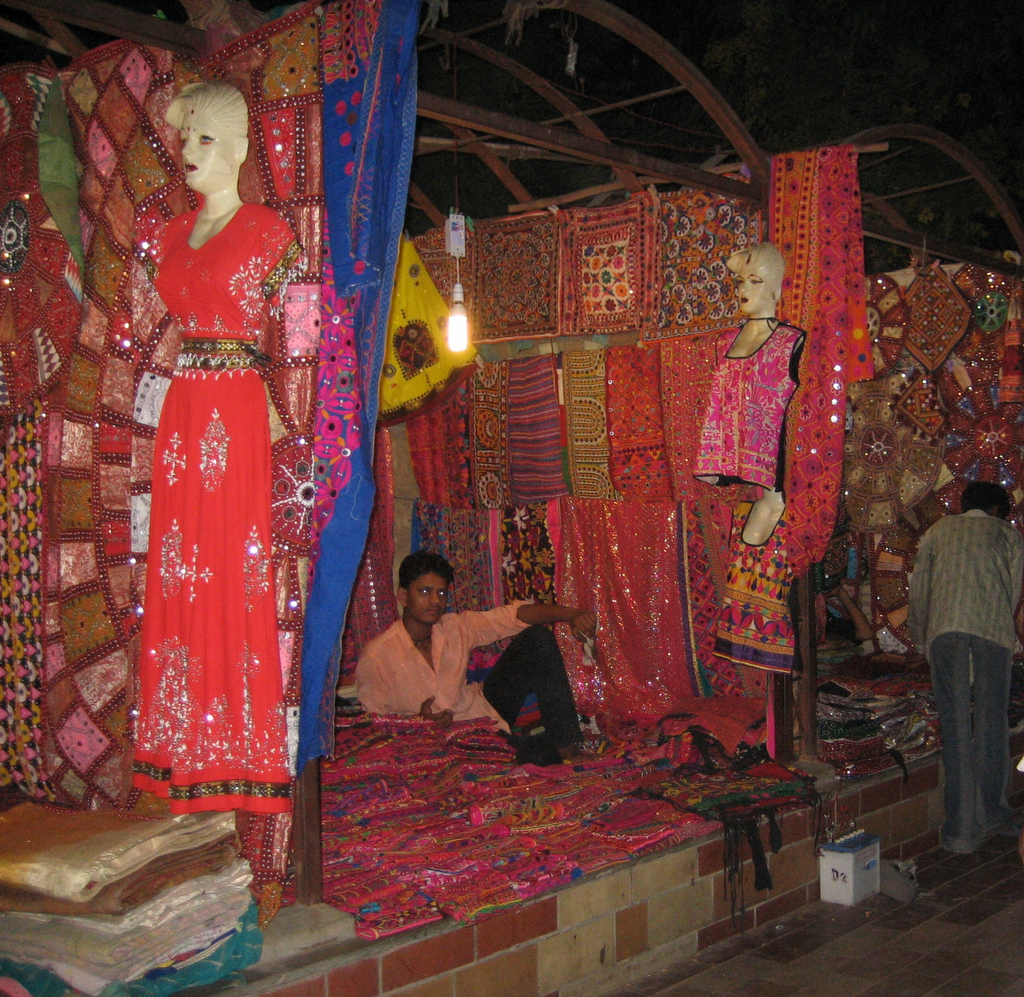
Street Retail in Ahmedabad's Night Market

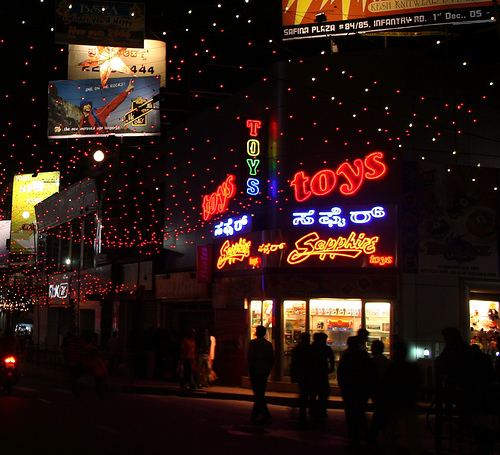
I raise the possibility that consumerism may not be a good fit for Indian society because Indian retail models, many of which appear to be based on high employee-to-customer ratios, are simply not conducive to browsing. For example, in Bangalore one day, my wife and I decided to step into a toy store (the one on Brigade Rd. for those of you who are locals) with our two children—at the time aged 3 1/2 and almost 2. We were perplexed when we encountered a virtual wall of employees making it impossible to push one's way through the store. Employees actively discouraged our children from browsing by taking from them the toys they had picked up and placing them back on the shelves. My sense is that the high employee-to-customer ratio approach is based on a belief that the employee can best tell the consumer what he or she needs. Another example should illustrate what I mean.


Photo by flickr member "grande illusion"

Jewelry shopping in India is serious business, and given the cultural significance of gold, perhaps whatever I observed in jewelry stores is less an attempt to strive for American-style consumerism and more a function of unique cultural characteristics. Nevertheless, my observations are worth noting. As at the toy store, jewelry stores operate with a high employee-to-customer ratio. The customer is constantly tended to, whether providing a chair to sit in or a cup of tea to drink. But as with the tiny shops in a typical Indian market or bazaar, browsing is not possible. At the jewelry store, however, the reason has little to do with space and everything to do with the fact that over-attentive employees insist on bringing the products to the customer. In one case, my wife described to an employee the type of earring she wanted. The employee then proceeded to bring her styles of jewelry completely inconsistent with her expressed preference.

Another type of store that employs some of the same “overwhelm-the-customer-with-attention” techniques is what I suppose you could call the silk superstore, or textiles-only department store. Upon entering one such store, a chain in Kerala called Jayalakshmi, we were instantly bombarded with attention from at least 8 to 10 of the 30 or so employees working the main floor. We were instantly asked what we were looking for. In the practice of browsing, the consumer only knows what she or he is looking for after it is discovered. Discovering what one is looking for is challenging with an employee always at one’s heel. And if the customer has a purchase in mind, and shares this information with an employee, the employee then becomes the expert in determining what the customer wants.

House of Alukka's: A Major Kerala Jewelry Store Chain

Now, back to my point. These examples of what can best be described as awkward approaches to customer service are probably in some way an outgrowth of an attempt by India’s retail sector to woo the reluctant Indian consumer. In time, I am sure retail in India will develop new models that are conducive to more spontaneous consumerism. If so, then why is this a problem? Again, as I set out at the beginning of this entry, the problem has to do with the way that consumer capitalism forces the transformation of certain existing cultural traditions in the interest of expanding markets and constant growth. Top-down, market-driven change represents a homogenizing force. After a certain length of time, India will cease to look like India. Instead, it will look a lot more like American society.

Obviously Indians will still eat different foods, practice different religions, and speak different languages than Americans, and there will still be plenty of internal diversity (just as American society has racial, ethnic, and religious diversity). But all of the richness and diversity of India’s cultural traditions will be diminished. Rather than at the well or open-air market, Indians will find community at the mall or Wal-Mart, the way many Americans do. Americans lack a culture rooted in historical traditions based on religious, utilitarian, and other approaches to functioning in everyday life. Instead, our culture is rooted in the transience of fashions and fads manipulated by profit-seeking capitalists. The harder India tries to become a consumer society, the greater the likelihood that its culture will follow the same path.

Already, in the last ten to fifteen years, much of the richness of Indian culture has been diminished. Beautiful terra cotta vessels, once used throughout India to collect and transport water, have been largely replaced by brightly colored plastic vessels. Similarly, today one is hard pressed to find chai served in disposable and biodegradable terra cotta cups. Instead, train passengers receive their chai in plastic or paper cups. At a deeper level, as India’s rural regions become transformed by the forces of globalization, people are abandoning traditional handicrafts and other ways of life that evolved over thousands of years.

I realize that I am once again verging on a romantic and monolithic notion of Indian culture. I’ll take whatever criticisms come my way. But let me make it clear that I am not suggesting that India resist consumerism in order to preserve some quaint, idealized version of Indian culture. Instead, I’m trying to be provocative and to compel Indians to begin asking some difficult questions about what is most valued about India’s cultural heritage, about what is worth preserving, and about what parts of Indian culture are vital to what it means to be Indian, as diverse a set of meanings as that identity might hold.

In a way, these are some of the questions that Vroom, the character from One Night @ The Call Center who I discussed in the last installment of this series, was asking. Vroom is calling for India’s youth to question consumerism and to look inward for a more authentic sense of identity and source of meaning in life. I use the example of Vroom because his is likely a more credible, and definitely a more widely heard, voice than my own. In fact, some might argue that it is hypocritical for me, an American, to ask Indians to question consumerism’s hold on them. After all, Americans have long since embraced consumerism and accepted the commodified form of culture that comes with it. I would counter this critique by pointing out that in the U.S., except for the Native Americans who Anglo-Americans had largely obliterated by the early 20th century, there were no longstanding cultural traditions to protect. It was partly because of the lack of identity on the part of displaced British colonists that consumerism as a source of identity was able to take root in America.

The situation is fundamentally different in India. For Vroom, that India’s youth are embracing the consumer lifestyle is troubling because it is a lifestyle being sold to it by the same people who they are helping in the call centers. I think Vroom is contending that if the youth generation does not opt out of this lifestyle, they, as much as any multinational corporation or government economic policymaker, will be responsible for India’s failure to realize its real potential. In a broader sense, I think Vroom’s fear is that India, and India’s youth in particular, is becoming trapped in a consumerist lifestyle that once embraced cannot easily be abandoned.

In the final installment of this series, I will focus on the way in which American consumer culture creates a convenient bubble, within which the consumer is comfortably oblivious to the consequences of the consumer lifestyle. This is achieved, in part, by shipping off to other countries much of the dirty work—the resource and labor exploitation—involved in delivering to us our consumer goods. I’ll conclude the series by asking whether the same relationship will hold for India. Can India “ship off” the ugly dark side involved in the production of consumer goods so that its consumers can live in the same sort of denial as American consumers?

Saturday, August 26, 2006

Consumerism in India: A Faustian Bargain? (Part 3 of 5)

Consumerism, Identity, and Resistance in India
In Parts 1 and 2 of this series, I defined consumer culture and then discussed some of the consequences of finding an identity within a consumer society that is characterized by a rapidly shifting, and therefore unstable, system of cultural meanings. But what does all of this have to do with India? The obvious answer is that inasmuch as India continues down the path of a consumer society, citizens in India will increasingly take on all of the problems with consumerism as a form of social organization that were discussed in Part 2.

In this installment, I want to explore whether there is any evidence of concern among Indians about the transition to a consumer culture. I think there is evidence, modest though it may be. To illustrate, let me turn to Chetan Bhagat's One Night @ The Call Center, a fictional book about six employees at Gurgaon call center. The book, which is a bestseller in India, is less about life working in a call center, and more a vehicle for the author to critique India's headlong rush into consumer capitalism. For a summary, see here. For blogger reviews, see here or here.

In the following passage, the characters are returning to their call center after an extended break at a nearby nightclub. Shyam, the main character who seems to be complacent with being a team leader at his call center with the potential to move up the call center hierarchy, is talking to Vroom, who continues to work in the call center despite having deep reservations about its effect on him and his generation:
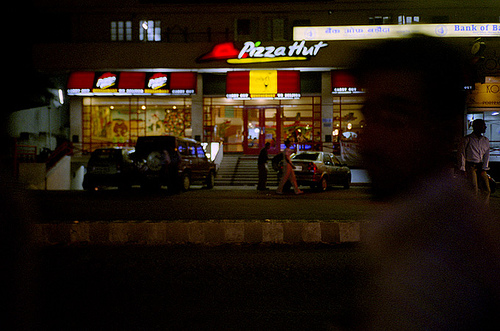
At the corner of Sahara Mall we passed by a Pizza Hut. It was closed. Vroom went up and stood in front of it. I wondered if he had really gone crazy; was he expecting pizza at this time?
We stood near the entrance. On our right, there was a thirty-foot wide metal hoarding of a cola company. A top Bollywood actress held a drink bottle and looked at us with inviting eyes. Like a fizzy drink was all it took to seduce her into bed.
Vroom walked close to the actress’s face.

Photo by Flickr member "afterimagery"

‘What’s up dude?’ I said.
‘You see her?’ Vroom said, pointing to the actress.
I nodded.
‘There she is, looking at us like she is our best friend. Do you think she cares for us?’
‘I don’t know. She is a youth icon man,’ I shrugged my shoulders.
‘Yes, youth icon. This airhead chick is supposed to be our role model. Like she knows a fuck about life and gives a fuck about us. All she cares about is cash. She doesn’t care about you or me. She just wants you to buy this black piss,’ Vroom said, pointing to the cola bottle. (p. 211-212)
As a sociologist, I am interested in the reasons for this book’s popularity. The success of the author’s first book, Five-Point Someone, offers a partial explanation. Another explanation is that there is a message that resonates with readers at some level. Vroom is speaking for a segment of the population that is disillusioned with global capitalism’s promise that consumer culture is India’s economic salvation.

Photo by Flickr member "patangay"

Near the end of the book, Vroom speaks even more explicitly for his generation, the “youth generation:”
The government doesn’t care for anybody … Even that “youth special” channel, they don’t care either. They say youth because they want the damn Pizza Huts and Cokes and Pepsis of the world to come and give their ads to them. Ads that say if we spend our salary to have pizza and coke, we will be happy. Like young people don’t have a fucking brain. Tell us what crap to have and we’ll have it. (p. 213)
And then, in a speech aimed at saving the call center from lay-offs that Vroom and Shyam’s manager calls “rightsizing,” Vroom offers what could be considered a rallying cry for his generation:
My friends, I am angry. Because every day, I see some of the world’s strongest and smartest people in my country. I see all this potential, yet it is all getting wasted. An entire generation up all night, providing crutches for the white morons to run their lives. And then big companies come and convince us with their advertising to value crap we don’t need, do jobs we hate so that we can buy stuff—junk food, colored fizzy water, dumbass credit cards and overpriced shoes. They call it youth culture. Is this what they think youth is about? Two generations ago, the youth got this country free. Now that was something meaningful. But what happened after that? We have just been reduced to a high-spending demographic. The only youth power they care about is our spending power. (p. 253)
Vroom wants to know why his generation is up all night working in call centers and not hard at work building up India’s infrastructure, discovering alternative energy sources, reforming its government, or in other ways changing the country for the better. Instead they are stuck inside the call centers, working through the middle of the night, so that they can have enough money to buy the cultural commodities of the very people whose problems they are solving in their call center jobs. In a sense, Vroom seems to be asking "Will the embrace of consumerism have been worth it if in the process Indian’s lose a sense of what it means to be Indian?"

Photo by Flickr member "k1mk1m"

There are some very interesting parallels between Vroom’s speech to the youth generation at the end of One Night @ the Call Center, and Karan’s speech over the airwaves at the end of the top-grossing film "Rang De Basanti." In a future post, I’ll discuss the similarities between these two recent Indian pop culture phenomena, the most striking of which might be that both One Night @ the Call Center and "Rang De Basanti" received very strong, and very mixed, responses from readers/viewers. In both cases, it seems that people either hated or loved the book/film.

Now back to my point. Vroom’s concern has to do with the potential for the lure of consumer luxuries to stifle the talents and promise of an entire generation of Indians. For me—and I’ll admit I am merely someone with some training to understand social organization and social change who also happens to have lived in India for six months—the problem with consumer capitalism is the way in which it forces the transformation of certain existing cultural traditions in the interest of expanding markets to meet the system’s demand for constant growth.

I understand that this is sensitive terrain I am now treading. I certainly do not mean to romanticize India or its culture. Nor do I want to lump all Indians into one category. But there seems to be no denying that consumer capitalism is brining changes to India. Indeed, every Indian I spoke to about these matters admitted that India is experiencing rapid change. The changes will mean different things for different people, depending on who you are or where you fit into the cultural mosaic of India. Ultimately, every Indian should be asking “What will the future India look like if change continues to be driven by a market orientation rooted in the culture of consumption?”

I’ll offer one possible answer to this question in the next installment of “Consumerism in India: A Faustian Bargain?”


Technorati tags: ,

Friday, August 18, 2006

Consumerism in India: A Faustian Bargain? (Part 2 of 5)

The Social Costs of Consumerism

Photo by flickr member "Dreamer7112"

In the previous entry in this series, I offered a definition of "consumer culture." In this entry, I will discuss why, given this definition, consumer culture is problematic.

Historically, cultures have maintained social order by defining needs and desires appropriate to particular people at particular times. A consumer culture views needs and desires as uniquely individual and limitless. Social order, in turn, becomes destabilized. Where social order is uncertain, the development of a meaningful and stable self is disrupted. Furthermore, because consumer culture commodifies everything, space outside the marketplace ceases to exist. Consumers who want to return to being citizens, and who want to begin to create new meanings and impute new values to themselves and the social order, cannot find nor create social space in which to do it.

In short, consumers eventually find troublesome the attempt to make life meaningful inside the almost infinite world of consumer goods. This is what I observed among the subjects I studied in 1998, as part of my dissertation on the Voluntary Simplicity movement in the U.S. The "simplifiers" I interviewed and surveyed all had chosen to simplify their lives after becoming exasperated with the stress of making life meaningful through the consumer lifestyle. Most of the subjects I interviewed experienced a crisis of self—a moment in their lives when they asked themselves “Who am I?” All the consumer goods, though useful in constructing various facades, had failed to provide them with an authentic sense of self.

Admittedly, only a small number of people ever reach this point of crisis. But consider the possibility that most consumers are on a trajectory towards such a crisis. Some of us will reach a crisis point and reject consumerism as a source of self-meaning. Others may reach this crisis but decide that the problem is not consumerism itself, but consuming the right set of goods. The American mid-life crisis—in which the individual disposes of old possessions and constructs a new self-identity by consuming new fashions, a new car, or other new material goods—exemplifies this strategy. Still others may go on convincing themselves that material goods will make them happy and give their lives meaning, while in denial that something about this strategy is unsettling. Finally, there may be some individuals who can truly find happiness and a deep sense of self-meaning through the acquisition of material goods. But if this number is small, is a consumer culture really the best way to go about structuring our social lives?

Whichever category we fall into, all consumers must spend time negotiating our way through the sea of advertising messages urging us to define our identities through consumer goods requires great psychological work. Consumers must filter, process, and/or avoid selling messages that are mostly superfluous and unsolicited. When marketers portray the goods and services they promote as indispensable vehicles for the realization of such virtues as authenticity, self-worth, happiness, and fulfillment, consumers are forced to invest time and energy into evaluating the extent to which one consumer choice or another will garner them the cultural assets (e.g., esteem, prestige, love, belongingness) they may be seeking.

Photo by flickr member "y entonces"

But if there are psychological prices to pay for life in a consumer society, some might suggest those unable to pay the cost should simply opt out. According to this argument, failure to acquire important cultural resources by making choices within the consumer marketplace, and the social and psychological burdens following from such a failure, are the fault of the individual. This is certainly consistent with the individualistic orientation of selfhood advocated by Americans. But such a narrow vision is flawed for two reasons.

First, it assumes that our consumption practices are only meaningful from the point of consumption onward. After all, we consume to convey meanings about ourselves to others. This is the symbolic universe of consumerism. But there is a material universe as well. In this universe, the material goods we consume have real consequences in the lives of people who live in and around the places where the goods are manufactured and later disposed of. Failure to function within the symbolic universe of consumerism may be due to consciousness of, and concern for, the consequences of consumption in the material world.

The second problem with the narrowness of the “blame-the-individual” response is linked to the first problem discussed above. The problem is that not everyone has the option of opting out, now matter how strongly one might object to a social system in which cultural resources essential to self-survival and to the maintenance of the social structure are procured through the consumer marketplace. On the contrary, some people are excluded from ever opting in. This problem may be less pronounced in a country like the U.S. where the widespread availability of consumer credit gives all but the most marginalized members of society an opportunity to opt into the consumer lifestyle. But in a country like India, where at least half of the population is currently excluded from the shopping malls and multiplex cinemas, “opting out” is a ridiculous notion.

One danger of consumer capitalism is that it carries with it a legitimating rationale that allows us to dismiss members of society too marginalized to participate in the consumer lifestyle. According to consumer capitalism’s legitimating rationale, a consumer society is a free and open society in which anyone who works hard has the opportunity to enjoy the fruits of her or his hard labor in the consumer marketplace. From this perspective, anyone left out of the consumer lifestyle simply has not yet worked hard enough.

This rationale also allows those with social advantages to justify consumption of luxury goods while fellow members of society around them live in unacceptable poverty. People who have worked hard to acquire wealth, the argument goes, should be free to spend their wealth in whatever ways they want. I will return to the problems with this argument in a later installment in this series. First I want to introduce a counterargument to the notion that life in a consumer society is burdensome.

What I have so far described as burdens, some perceive as valuable opportunities for acquiring the cultural competency needed to sustain a meaningful social existence. In fact, many people actively seek more marketing information than is available passively. People will pay an entrance fee to auto shows, wedding shows, boat shows, home shows, garden shows, and other types of product-based exhibitions. What do they get for their money? They get what they must perceive as valuable information about new products and other consumer goods and services. That people seek out this information suggests that marketing messages may not always be burdens, and in fact can be desirable commodities in and of themselves. Indeed, any time a consumer pays for the privilege of wearing clothing that doubles as an advertisement, she/he demonstrates that self-commodifying advertising is often perceived to be an opportunity rather than a burden.

In other words, the perceived burden of failing to create a meaningful self through socially expected ways (i.e., material goods) makes subjecting oneself to marketing messages worth the burden. In a consumer culture, mass-marketed consumer identities represent a form of almost universal currency (except for those too poor to opt into the system of meanings). Choosing to engage non-consumer-based identities, therefore, is like trying to exchange a form of currency that is not recognized in consumer cultures.

Photo by flickr member "ilmungo"

If consumer cultures existed within closed systems, it could be argued that they offer an elegant solution to the problem of identity and social order. The real problem posed by consumer cultures, however, has to do with the impacts of the flows coming into, and going out of, the societies in which consumer cultures function. By "flows" I mean the natural resources being exploited outside the system to create the meaningful goods inside the system, the material (and often hazardous) waste leaving the system, and the cultural creep wherein the meanings of the lifestyles and goods within the system begin to influence cultures outside the system.

In a world where various societies' cultures are almost instantly linked through telecommunications and the Internet, the creep of consumerism into other cultures is inevitable. This is not universally problematic. Many cultures have adapted to consumerism with little disruption to the social order. In India, however, the transition is taking place with such speed, and with such a disruption of previous forms of identity formation and livelihood, that there are already signs of disillusionment (as evidenced in the violence in Bangalore following Dr. Rajkumar’s death, which I wrote about in “30 Days: ‘Outsourcing,’ The American Perspective (Part 1 of 2).”

I’m not proposing that India, or any society, should reject consumerism. In theory, there are certainly better alternatives. In practice, consumerism is the only option for many societies. My main hope is that, somehow, societies beginning to embrace consumerism can evolve their own unique consumer cultures that not only produce thriving economies, but that also, and more importantly, offer people more meaningful and less market-based ways to develop a sense of self.

In the next installment in this series, I’ll explore the possibility of such an alternative form of consumer culture evolving in India by focusing on a few signs of resistance to the creeping culture of consumerism.

Technorati tags:

Tuesday, August 15, 2006

Consumerism in India: A Faustian Bargain? (Part 1 of 5)

In Part One of this series, based on a lecture I delivered at the University of Calcutta in March 2006, I define “consumer culture” and begin to discuss some of the implications, good and bad, for individuals living in a consumer society.

Note: I'm grateful to Joe Rumbo, with whom I originally developed and wrote about some of the ideas in this series.

When the University of Calcutta’s Department of Business asked me to offer a lecture on “anti-consumer” attitudes, I was grateful for the opportunity to revisit research I had done several years earlier on this burgeoning phenomenon among a small but significant number of Americans. At the time of my lecture, I had been in India for four months working on research about struggles against multinational corporations that pollute local environments and harm people’s health. Much of this pollution is the direct result of the manufacturing of goods for Western consumers, and increasingly for the growing number of new middle-class Indian consumers.

The basic logic goes like this: Capitalism requires a constantly expanding economy. Economic expansion takes place, among other ways, through the mass production of more goods in more efficient ways (efficiency is achieved by reducing the cost of inputs like raw materials and labor). These efficiently produced goods then need to be consumed. With saturated consumer markets in U.S. and most of the developed world, countries like India represent the next great hope for capitalists looking for new consumers.

There are two forms of pollution in this process. The first is the obvious environmental pollution that results from manufacturing processes (e.g., the chemicals that are emitted into air and water in the process of manufacturing plastic and electronics for the production of mobile phones). In this essay, I want to focus on the other type of pollution that results. I call this second type of pollution the pollution of culture and mind. It results as the proliferation of consumer goods, and the cultural meanings ascribed to these goods--meanings that are mostly created by the agencies marketing the goods but also to a lesser extent by the people consuming the goods--transforms a culture. As the culture becomes transformed, marketing messages and the system of meanings attached to material goods begin to occupy more and more of our mental space.

Environmental pollution is a profound problem, but can be addressed by a combination of technical solutions and social restructuring. Pollution of culture and mind is more difficult to address because we don’t see it as a problem the way we see people suffering from exposures to industrial hazards as a problem. Even if we did see it as a problem, there are no technical fixes and we lack a vocabulary or discourse for thinking about solutions.

So, the question I want to explore is whether, in the process of pursuing developed-world levels of economic growth, India is “selling its soul” as the legendary Faust is purported to have done (and as some might argue the U.S., the unparalleled consumer society in the world, has already done)? I’ll begin by defining what I mean by a consumer culture, and in the next installment I will discuss some of the downsides of the American consumer society in order to highlight some of the changes western-style consumerism is likely to bring to India.

Consumer Culture Defined
As a sociologist, I should begin with a distinction between society and culture. A society can be defined as a group of individuals bound together by a set of social arrangements, sometimes called social structures, intended to facilitate the accomplishment of certain essential tasks to sustain itself. These tasks include, but are not limited to, reproduction of members, production and distribution of food, clothing, and shelter, maintenance of health, education of its members, and the passing on of the patterns and practices that govern the society.

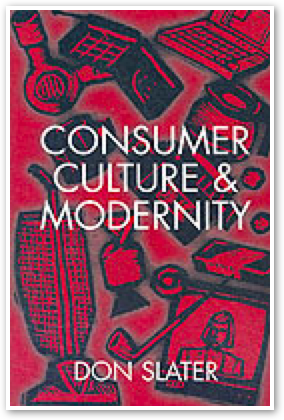
Culture, which can be viewed as a set of tools people use to function in society, has a certain amount of overlap with the above definition of society. I will define culture as the tangible and intangible, or material and symbolic, resources available to the members of a society to carry out the tasks needed for sustaining itself. Thus we arrive at a more formal definition of consumer culture, which I borrow from a book titled Consumer Culture & Modernity:

“[Consumer culture is]… a social arrangement in which the relation between lived culture and social resources, between meaningful ways of life and the symbolic and material resources on which they depend, is mediated through markets” (Slater, 1997, p. 8)

In other words, in a consumer culture, the role of the consumer is to find and purchase in the marketplace whatever material or symbolic resources she or he needs to function in society. Status, prestige, esteem, love, and even salvation—in a consumer culture, all of these intangibles are available in the marketplace. This is not to say that one can no longer gain the admiration of others through good works alone. But as more and more individuals purchase the goods that earn them the admiration of others, genuinely earned admiration is cheapened. Cultural meanings and values become encoded in material goods, and eventually it becomes easier to communicate information about oneself through possessions than through deeds.

In a consumer culture, everything we need to function in everyday life—from food and shelter to gossip and fun—is obtained primarily through markets. Culture continues to be produced and reproduced through forms of consumption that take place outside of markets, but consuming in the marketplace becomes the default strategy for making everyday life meaningful.

For now, I don’t want to place any value judgments on consumer cultures. There are many useful aspects of consumer cultures, some of which I will talk about in future installments in this series. I begin with this definition so that we can start to think about what it means for a society when it makes a transition from one type of culture--for example one derived largely from religious beliefs and traditions--to another type of culture such as a consumer culture.

All significant cultural shifts unsettle the members of a society in some way. Is there something about the shift to a consumer culture that results in a greater amount of anxiety or even social disorder than the shift, for example, from earlier cultural traditions to the Age of Enlightenment? I know I am using the idea of culture rather loosely in suggesting that the Age of Enlightenment represents a unitary culture, but just consider the question for the sake of discussion. If there are past cultural shifts that have similarities to the shifts many contemporary cultures are making to a consumer culture, then we ought to understand these past shifts in order to better prepare for today’s ongoing transformations to consumer cultures. And if there are not similarities, then we need better critical thinking about what is happening around the world today.

Consumer cultures will be the dominant global cultural form by the end of this century. In the remainder of this series, I hope to make a modest contribution to understanding what this transformation means with respect to India. My hope is that my ideas start some dialogue that might help today’s cultural leaders make the transitions to consumer cultures smoother for their societies.

Technorati tags:

In HyperCity, India Gets Big Box Retail


For better or worse, big box retail has arrived in India. Yet another sign of the dramatic changes India is undergoing.

Back in April, K. Raheja Corp. Group, a real estate and retailing giant in India, opened a 120,000 square foot HyperCity retail store in Malad, a Mumbai suburb already known for another K. Raheja Corp. project, the Inorbit Mall. The company plans to open somewhere between 35 and 50 more HyperCities throughout India's tier-I (e.g., Delhi, Bangalore, Chennai) and tier-II (e.g., Mangalore, Aurangabad, Lucknow) cities in the next ten years.

How much does this emerging market for big-box retail in India really represent a changing India? After all, only a very small percentage of India's population can afford to shop at a place like HyperCity. Nearly half of Mumbai's population, almost 6 million people, live in slums like
Dharavi--ignominiously known as Asia's largest slum--and aren't likely to make it to the suburb of Malad, a good hour away by car or train. But poverty is meaningless when people embrace consumer debt. HyperCity seems to be anticipating a growth in the acceptance of consumer debt more than any sort of real economic prosperity among the country's poor. This may sound cynical, but when you learn that HyperCity has partnered with Hong Kong bank and Citi Financial to make sure rupee-less consumers can still make a purchase, it sounds more like the reality:

"It's our way of telling shoppers--if you don't have money to pay for something now, don't fret," according to HyperCity's South African CEO, Andrew Levermore, in an interview on
rediff.com.

Until very recently, this sort of consumer debt was unheard of in India. Levermore also has his eye on other ways in which the Indian consumer is changing:

"We have a phrase here: 'It won't work in India - IWWII,' " Levermore recently explained in an article in The Guardian

"I was told Indian housewives want to handle their vegetables. They don't. They like it just like everywhere else: clean, wrapped in cellophane and free from everyone else's grubby fingers."

Let's return to the question: How much does a place like HyperCity really change a country of more than a billion people, especially when 97% of all retail spending in the country--a total of $258 billion--happens in traditional family-run shops taking up, on average, about 500 square feet of space? (statistics are from The Guardian article cited above).


If HyperCity proves to be anything like Wal-Mart, it has the potential to lead to vast change.

A small aside...
Admittedly, there is ongoing debate about the precise impacts Wal-Mart has on small businesses, rural communities, global supply chains, and workers and working conditions. But even if, on balance, there is a net "good," the fact that there is such opposition to Wal-Mart in the U.S., as evidenced not least of which by the many small towns fighting legal battles to keep Wal-Mart out of their communities, says something about perceived impacts.

Back on point...
If even a small fraction of the people working in India's current mom-and-pop retail sector wind up out of business, The 340 or so jobs created by each HyperCity will hardly balance the losses.

Of greater concern may be the way HyperCity is following the American big box model of suburban development. This is where land is cheapest, so obviously HyperCities, which are land-intensive enterprises, will be located in suburban areas. But unlike some of the uncertainties surrounding social impacts of Wal-Marts, the environmental impacts of Wal-Mart-style development are fairly well documented (for a conservative government view, see NASA's website on the use of satellite images to understand sprawl's environmental impacts; or Sierra Club's website for a good article on the link between big box sprawl and climate changing CO2 emissions).

But maybe the HyperCities of India, and other retailing magnates hoping to follow in HyperCitiy's footsteps, understand the social and environmental impacts their operations will have. This is what K. Raheja Corp. says about its commitment to social responsibility:

...increasing urbanisation leading to spiralling prices of real estate and higher pollution levels have necessitated the need to provide more green cover. At K. Raheja Corp, we identified this need and developed parks, children's play areas, beautiful traffic islands and similar facilities to do our bit towards creating a more equitable environment.

American companies who have made promises of social or environmental responsibility haven't always delivered on their promises (though what Wal-Mart does with its new image makeover, which includes a commitment to a sweeping environmental initiative, will be interesting). In the case of the K. Raheja Corp., I'm not sure that adding a little green cover is going to balance the impacts its development projects have. But I'd like to move away from the environmental impact argument anyway. It's too easy for critics to dismiss arguments coming from the west that the global south should reduce its environmental impacts to help save the world from the consequences of climate change.

Instead, let me conclude by suggesting that India should move ahead not just with HyperCities throughout India, but also with the opening up of foreign direct investment for retailers like Wal-Mart, Target, Home Depot, and Best Buy. I say this partly tongue-in-cheek. But in all seriousness, this seems to be the inevitable end toward which India is headed. Furthermore, real competition might mean that the company with the retail model that is most consistent with current Indian preferences and values will win out. Carrefour and Wal-Mart both learned following their failures in South Korea that a successful retail model in one part of the world doesn't always translate to another part.

Regardless of how the big box retail revolution in India proceeds, I would hope that Indians are able, in a way that Americans could only do after the fact, to anticipate and respond to the changes big box retail will bring: from the weakened social networks resulting from the vanquishing of local retailing and the increased time spent in automobiles to reach the new mega retailing outlets, to the increased individualism and diminished communitarianism resulting from the heightened focus on self-image and the pursuit of happiness through material goods that comes with the type of consumer capitalism epitomized by big box retail.

If, in fact, big box retailing proceeds in India in a way that is sensitive to local customs and values (here's where I become highly skeptical of my own hopes), then perhaps Levermore, the HyperCity CEO, will be right when he claims that "HyperCITY exemplifies all that India should be proud of," (from an article in The Telegraph.)

Technorati tags: ,