Showing posts with label Indian economy. Show all posts

Thursday, March 15, 2007

Business Week's "The Trouble with India"


What is "The Trouble with India?"

The headline of the cover story of Business Week's March 19 issue appears to offer some skepticism about all the "India Rising" rhetoric that has come out of Time (see “India Inc.” cover story June 26, 2006), Newsweek (“The New India,” March 6, 2006 cover story), The Economist (“Can India Fly?” June 3, 2006) and other mainstream U.S. news magazines over the last year.

In the end, however, Business Week's "The Trouble with India" seems to suggest that amidst some of the obstacles to continued growth are more opportunities for innovation (and, in turn, growth).

The article's author, Steve Hamm, author of the Wipro-focused book Bangalore Tiger, even writes in his blog:

I spent nearly a month in India late last year reporting for the story, and, I must say, I became emotionally wound up in the efforts by hundreds of Indians I interviewed to create what some of them called a New India. They weren't just talking about the economy, either. The country's sometimes disfunctional politics and widespead corruption are a heavy burden on its economy. To me, the most powerful force in India is hope. I believe the Indian people can throw off the shackles of bad government and corruption the way they did colonial rule. But it won't be easy.

I think the article can be interpreted a number of ways. In fact, all of the recent articles touting India's growth and potential also acknowledge the infrastructure and corruption problems. But Hamm's article, despite its ultimate optimism that somehow the sheer force of India's economic momentum will resolve its infrastructure problems, seems to be one of the first to focus explicitly on these obstacles.

In the Indian blogosphere, Random Thoughts of a Demented Mind's Haseena Atimbum takes aim at Hamm's reporting here. Indra Drishtikona briefly mentions the article here. There's a brief mention of the article at a number of other blogs. At milieu Sreekumar raises the interesting question of how to balance investment in insfrastructure with social sector investment. Om Malik, at GigaOM, believes "the infrastructure and other issues are linked to the agricultural sector."

In both print media and the blogosphere, I'd like to see a more constructive discussion of India's infrastructure challenge. Are there positive models of infrastructure development that can be packaged and implemented in other parts of India? Is there any critical thinking about how to prioritize infrastructure needs? And, finally, has anyone really laid out with clarity the obstacles to infrastructure development, beyond merely pointing the finger at "corruption?"

Tuesday, February 27, 2007

India Rising Redux

A recent BBC series titled "India Rising" takes what I think is one of the more balanced approaches to the question of whether India's growth is benefiting the rural poor.

The series was part of a larger week-long BBC focus on India that ran 3-11 February.

I've blogged about the "India Rising/India Shining" rhetoric before, so I won't add my views here. Instead, here's a synopsis of each episode in case you can't listen to all five:

Episode 1 "New Wealth": The economic optimists, whose only complaints are government corruption and inadequate infrastructure, dominate this episode.

Episode 2 "Inside India's Heart of Darkness": The life of rural villagers in Bihar

Episode 3 "TV Nation": My personal favorite, this episode asks tough questions about changing Indian culture and the adoption of consumerism without taking sides.

Episode 4 "Can it All Hang Together?": Mostly set it Chattisgarh, this episode asks whether India's social fabric will be torn apart by people, such as Naxalites, who perceive that the headlong rush towards development is leaving some people worse off than they were.

Also, for any readers in India, you might be interested in a BBC photo contest. You must be in South Asia and your photo must be taken with a mobile phone. Sounds interesting...

Sunday, December 17, 2006

Follow-up on Yunus/Grameen post

I finally had a chance to read the full text of Muhammad Yunus' Nobel Peace Prize acceptance speech. I was glad to see Yunus make explicit the link between pverty and peace. Back in October, when it was announced that Yunus/Grameen had won, I posted an entry summarizing what various people were saying about Yunus and about the Nobel committee's decision.

In that post, I quoted an editorial from The Economist that argued that Grameen and Yunus did not deserve an award reserved for peacemakers: "This year’s winner is an admirable anti-poverty campaigner, but it is a stretch to call him or the Grameen bank peacemakers." I then went on to argue that The Economist must not understand that peace is much more than the absence of war. Yunus' speech, from which I quote at length, made this point beautifully:
By giving us this prize, the Norwegian Nobel Committee has given important support to the proposition that peace is inextricably linked to poverty. Poverty is a threat to peace.

I believe terrorism cannot be won over by military action ... We must address the root causes of terrorism to end it for all time to come. I believe that putting resources into improving the lives of the poor people is a better strategy than spending it on guns.

Peace should be understood in a human way − in a broad social, political and economic way. Peace is threatened by unjust economic, social and political order, absence of democracy, environmental degradation and absence of human rights.
Finally, Yunus revealed his sociological intellect when he described the self-fulfilling prophecy of poverty:
We get what we want, or what we don't refuse. We accept the fact that we will always have poor people around us, and that poverty is part of human destiny. This is precisely why we continue to have poor people around us. If we firmly believe that poverty is unacceptable to us, and that it should not belong to a civilized society, we would have built appropriate institutions and policies to create a poverty-free world.

We wanted to go to the moon, so we went there. We achieve what we want to achieve. If we are not achieving something, it is because we have not put our minds to it. We create what we want.
In my previous post on microfinance, I sung its praises without also acknowledging its limits. For example, microfinance is not ideally suited to complete capital-intensive infrastructure projects (e.g., water provision, sanitation, road construction and maintenance, etc.). But Yunus, in his speech, elaborated on the concept of social businesses. Such businesses, when focused on needs other than microfinance, may develop the capacity to deliver larger-scale infrastructure projects. According to Yunus, social businesses
will be a new kind of business introduced in the market place with the objective of making a difference in the world. Investors in the social business could get back their investment, but will not take any dividend from the company. Profit would be ploughed back into the company to expand its outreach and improve the quality of its product or service. A social business will be a non-loss, non-dividend company ... The challenge is to innovate business models and apply them to produce desired social results cost-effectively and efficiently. Healthcare for the poor, financial services for the poor, information technology for the poor, education and training for the poor, marketing for the poor, renewable energy − these are all exciting areas for social businesses.
In Grameen, Yunus has already given us a social business that provides financial services to the poor. Let's hope that in another five or ten years we're celebrating a Noble Prize winner who, following in Yunus' footsteps, pioneered a social business that educated or provided health care for the world's poor. Such achievements are vital to a future world in which peace prevails.

Technorati tags: , , ,

Tuesday, November 28, 2006

The U.N. Global Compact: Why are Indian Companies Faltering?

First off, my apologies to the smattering of regular readers for such a gap between posts. In the academic calendar there are times of the year that are busier than others, and the last month has been one of those times. But the semester is near an end, and after I complete the manuscript I've been working on for a Dec. 1 deadline, I should have time to begin posting more regularly. Believe me, the ideas are stacking up.

For now, here's a quick post about the United Nation's Global Compact. The Global Compact was introduced in 1999 by (soon-to-be-former) Secretary General Kofi Anan with the aim of bringing together companies, UN agencies, labor, and civil society to commit to upholding ten universal principles in the areas of human rights, labor, environment, and transparency and anti-corruption.

The links above will take you to detailed explanations for each of the ten principles, to which companies may voluntary agree. So that you don't have to follow the links, here are the principles:
  1. Businesses should support and respect the protection of internationally proclaimed human rights; and
  2. make sure that they are not complicit in human rights abuses.
  3. Businesses should uphold the freedom of association and the effective recognition of the right to collective bargaining;
  4. the elimination of all forms of forced and compulsory labour;
  5. the effective abolition of child labour; and
  6. the elimination of discrimination in respect of employment and occupation.
  7. Businesses should support a precautionary approach to environmental challenges;
  8. undertake initiatives to promote greater environmental responsibility; and
  9. encourage the development and diffusion of environmentally friendly technologies .
  10. Businesses should work against all forms of corruption, including extortion and bribery.
On the corporate side, participation in the Global Compact involves a voluntary commitment to the ten principles. Companies are required to submit an annual "Communication on Progress" that details the steps they are taking to implement the principles. What does a company get for participating? It gets to participate in Global Compact events such as "Learning Forums" where companies share best practices for upholding the principles. A participating company also gets to use the Global Compact name and logo in promotional materials.

There's a lot of debate about whether the Global Compact really makes any difference in a company's conduct. My guess is that the difference, if any, is minimal. But when the Worldwatch Institute recently reported that the UN de-listed 335 companies from the Global Compact (the UN press release on the de-listing is available here), it occurred to me that the transparency of the Global Compact listing process gives average citizens ways to hold companies accountable. According to the UN, de-listing is a strategy to maintain the integrity of the Global Compact:
This step conforms to the Global Compact's Integrity Measures ... The Integrity Measures state that any company that has missed two consecutive annual deadlines to submit a Communication on Progress (COP) will be regarded "inactive" and marked accordingly on the Global Compact website.
Since the de-listed companies can be viewed at the Global Compact website, I compiled a list of the Indian companies that were de-listed:
  1. Bharat Aluminium Company Ltd.
  2. Bongaigaon Refinery and Petrochemicals Ltd.
  3. Cement Corporation of India
  4. Air India
  5. Dena Bank
  6. Central Cottage Industries
  7. Excel Industries Limited
  8. Hi-Tech Carbon
  9. Hindustan Organic Chemicals ltd.
  10. Engineering Projects India Ltd.
  11. Hindustan Aeronautics Ltd.
  12. Apollo Hospitals
  13. Mishra Dhatu Nigam Ltd.
  14. Mineral Exploration Corporation
  15. Mazagon Dock Ltd
  16. Mahanagar Telephone Nigam Ltd.
  17. Kudremukh Iron Ore Company
  18. Kolam Information Services PVT. Ltd
  19. Infrastructure Development Finance Company Ltd.
  20. Hindustan Sanitaryware and Industries Ltd.
  21. Hindustan Petroleum Corp. Ltd.
  22. Semiconductor Complex Ltd.
  23. Scooters India LTD
  24. Quadra Advisory Private Ltd.
  25. Punjab National Bank
  26. PSi
  27. Priconser India Pvt. Ltd.
  28. North Eastern Electric Power Corporation Ltd.
  29. National Textile Corporation Ltd.
  30. MMTC
  31. Wadia Group
  32. Unit Trust of India
  33. Transnational Supply & Service
  34. The State Trading Corporation of India
  35. The Shipping Corporation of India Ltd.
  36. Telco Construction Equipment Company Ltd.
  37. Tata Tea
  38. Tata Industries Limited
  39. TAL Manufacturing Solutions Limited
Some of these companies may have failed to submit a COP because they are no longer committed to upholding the principles of the Global Compact. In other cases, they may not have the resources to devote to developing a COP. Given the number of companies from developing countries among the 335 that were de-listed, I suspect there is a common obstacle preventing companies from maintaining their commitment.

Regardless of the reason, I figured readers of The Curious Stall might be familiar with one of the companies in the list, or even have a contact, and be able to find out why some of these companies have failed to submit their COPs. Perhaps through the blogosphere we can do a little collaborative research and put a little pressure on these companies to stay committed.

If you know anything about any of the companies listed above, even just general information about what kind of business the company is engaged in, feel free to post it here. Many Indian companies have no web presence, so it is difficult for me to find anything out from where I blog. Who knows, perhaps we can collect some information that might be useful to the UN's Global Compact office in providing better support to companies in developing countries that want to stay committed to the ten principles.


Technorati tags: , ,

Wednesday, September 27, 2006

Africa: India's next great source of labor?

Jen Brea at Africabeat recently blogged about a new World Bank book that says China and India are part of Africa's "Silk Road." The idea is that Africa is poised for great economic growth through increasing trade with India and China. According to the book's promotional site, it is the first attempt to offer "systematic empirical evidence on how the two emerging economic giants of Asia— China and India—now stand at the crossroads of the explosion of African-Asian trade and investment."

According to Brea, in her post titled "Africa as China and India's 'New Economic Frontier,"
There has long been chatter about labor shortages creating upward pressure on Chinese wages and the fact that Chinese products may become less competitive, if not in first world markets, then in China's own domestic market. This is where the potential for Africa to use its comparative advantage - a low-cost labor force - comes in. If that labor force were mobilized, it could produce products for Indian and Chinese consumers at lower prices than many Indian and Chinese producers.
My question is "Where does it all end?" When India begins depending on cheap labor in Africa, then where will Africans turn to find their cheap labor? And in the meantime, what will happen to the 600,000,000 Indians living in poverty whose own government bypassed them for even cheaper labor in Africa?

India has solved one problem, it has found a sound engine of economic growth. And from what I have read lately, it sounds like some of the IT sector growth is stimulating the manufacturing sector. There was a New York Times article earlier in September titled "A Younger India is Flexing its Industrial Brawn," about which Kamla Bhatt and chacko, among a few others, blogged. The main argument is that India has a younger population, no one-child policy, and hence a more robust workforce that is situated to step into the gap left if and when China falters.

Aside from the infrastructure and other obvious differences between India and China, India has another major hurdle to overcome: many manufacturing jobs require basic level of education, some even demand English language skills; at the very least, most manufacturing jobs require literacy, if not in Engligh then in Hindi. But the vast majority of the 600,000,000 Indians living in poverty, those who most need whatever new manufacturing jobs India creates, do not speak functional English, nor do many of them read or write in their mother tongues. So educating them, even just to the level to function in a factory job, is quite a challenge, and one that government after government has been unable/unwilling to take on.

But even before getting to that point, I want to return to my original question. Where does it all end? Does Africa have a labor pool that exceeds India's when it comes to the basic skills required for manufacturing jobs? If so, then maybe we'll see India shift its attention to Africa to get more cheaply the consumer goods its middle class increasingly demands.

But I don't think Africa is any better off than India (I realize I am comparing a country and a continent, crude as it is). The real race will be to see who will be the first to provide the basic social infrastructure needed to raise the labor pool to certain basic standards. Even then, in the greater scheme of things, I'm quite skeptical. The production-consumption cycle of global capitalism--a cycle in which prodcution processes are moved around the world to find the cheapest resources and cheapest labor, and completed goods are then moved back to the wealthiest parts of the world where they are consumed--is utterly unsustainable.

And, yes, I'll be the first to admit (since even environmentalists seem wary to bring it up), Americans must seriously consider lifestyle downsizing. We need to find ways to live richly without plundering the world's resources, and without setting a goal for the rest of the world that we simply cannot afford to have everyone achieve.

Technorati tags: , ,

Monday, September 25, 2006

"Primary financial cause of farmer suicides"

I'm still trying to carve out the time to post a critical sociological analysis of the farmer suicide issue in India. I'm compelled to make a brief post now, especially after reading "Just heart alone won't suffice," at The Indian Economy Blog (originally posted here on The Acorn), in which Nitin Pai writes:
It has been the The Acorn’s case that [the farmer suicide] crisis is caused by the government’s determined refusal to allow market forces to play in the agriculture sector. Its policies have created perverse incentives: leading to a scarcity in formal sources of credit that is the primary financial cause of farmer suicides.
Such a position is not surprising for a blogger who writes at The Indian Economy Blog. "The solution to India’s ‘agrarian crisis’, therefore," Pai continues, "lies not in government largesse, but in its retreat. It lies in making rural and agricultural markets work."

"Markets, markets, markets, let the markets do their thing," seems to be the refrain of free market believers like Pai. As a sociologist, I cringe at the notion of reducing social complexity to the abstract, and reified (the process by which our own socially constructed concepts become a part of our reality), notion of "market forces." On the other hand, I'll admit, the solution suggested in the end seems to make some sense:
Politicians, intellectuals and farmers all need to accept that small loans are more expensive and must be priced accordingly. Thus an answer to the credit needs of small farmers in India is to free up interest rates, not just in terms of regulation but in terms of acceptability. At the same time, the government should permit a whole spectrum of credit providers, formal and informal, to enter the field and compete with each other so that they can enhance the total credit flow and eventually bring down costs. No regulation can control supply and price simultaneously. So if more credit has to flow to farmers, the price (interest rate) must be deregulated. Initially it may go up, attract more players and then they will compete and bring down the rates. Ironically, this lesson from the housing and consumer finance market has been missed by our policy-makers. (Pai is quoting from here).
Sure, I can agree that there are some problems with the loan market. I just wish that the economists would take a step back and ask "Why are farmers in India borrowing money?" I need to do more research before I settle on the answers to this question. But my suspicions are that (a) the Green Revolution was the initial impetus behind more capital-intensive agriculture, and that (b) the Biotech Revolution has wratcheted up to yet another level the capital needed to farm in India today.

So let's not scoff at the "terrible and perverse incentive" created when Manmohan Singh promises money to help the widows of farmers who have committed suicide. They are simply the latest victims of at least 50 years of decision-making that has had unintended consequences. Economists have a nice short-term solution in the goal of fixing the markets so that loans are not so burdensome for farmers who are subject to uncontrollable forces like the weather. But in the long run, making agriculture increasingly capital intensive, as I believe the Green and Biotech Revolutions have, makes agriculture profitable only for large agribusinesses that can afford the overhead and absorb the losses when weather, insects, or other forces destroy their crops.

Two long-term solutions come to mind: (1) use microfinance mechanisms to wean farmers from the expensive inputs required for "conventional" agriculture and to transition them back to organic farming; (2) create "work transition" programs that can slowly move farmers into new types of work as their land is taken over by large agribusinesses (which do not create jobs).

Again, these are preliminary thoughts. I welcome all types of feedback. I am continuing to try to understand this issue and will write more on it in the coming weeks.


Technorati tags: , ,

Wednesday, September 20, 2006

Old colonial tricks in new bottles

Over at grist, an environmental news and commentary site, there's a nice post in the gristmill blog by Tom Philpott. Philpott lays the foundation for his argument by drawing on a 2001 book by author Mike Davis. The book, titled Late Victorian Holocausts: El NiƱo Famines and the Making of the Third World, uses as one example strategies employed by the British to gain from droughts in India:

Davis lays out in devastating detail (first chapter available for free here) how in the 1870s, high-living colonial administrators dismantled the old Indian system for handling droughts, replacing it with one in which the price of grain floated freely based on global supply and demand. Thus, when a drought struck a grain-producing region in India, the grain price surged. The only buyers who could then afford it happened to reside in merry olde England.

The subcontinent's railroad system, paid for by taxes imposed on the Indians, very efficiently carried grain being produced in the non-drought areas to ports for shipment to the mother country. Its cutting-edge telegraph infrastructure, also financed by colonial taxes, transmitted price hikes rapidly. Famine thus rippled throughout India, including in non-drought-stricken areas.

Tens of millions perished in a series of famines in late 19th century India; before, when drought struck a certain area, food would move in from luckier areas and famines were rare. Davis claims the English took advantage of these not-so-natural disasters to consolidate its grip on the subcontinent. It was all very efficient, really.

Philpott uses this example from Davis' book to draw a parallel to the neocolonialism of the biotechnology companies that sell Indian farmers expensive Bt cotton and other seeds. Only, because the Indian government, as part of economic liberalization, is pushing for an industrial agriculture system, there is no support to bail out farmers who wind up in debt and, after a failed monsoon or other disaster (natural or otherwise) have no crops to sell and no money to repay their debts.

In other words, in the 1800s the British used their might to impose on India a system in which the British could squeeze every last rupee out of the Indian farmer. What's the difference today? Seems like old wine in new bottles. The British are gone, but the west has managed to convince India of the virtues of free markets and expensive advanced technological solutions to age-old problems like famine. And in the place of the British, the Indian government itself is imposing austerity on the Indian farmer. Meanwhile, the EU and U.S. refuse to lower their subsidies for domestic farmers and tariffs against imported agricultural goods (a pretty good summary of the failed Doha round of WTO negotiations can be found here). It's quite a racket. And who benefits?


Technorati tags: , ,

Friday, September 15, 2006

Elsewhere on the "Diabetes in India" story

So far, most of what I've read in the blogosphere about the NY Times article on Type 2 diabetes in India can be categorized as "Yeah, it's a problem, we know it" (see here). At Sepia Mutiny, a post on the article has prompted 140+ comments, some of which suggest that the article fails to consider explanations for the rise in diabetes other than increasing affluence.

But over at pass the roti on the left hand side, Desi Italiana has posted a nice take on the issue. Titling her entry "'Modernity' and mithai: a deadly combo," Desi Italiana points out that the link between diabetes and increasing affluence calls into question all the "India Shining" rhetoric. "What's funny," she points out, "is that despite the facts that the author provides - such as the lack of health care and health insurance, the 300 million hungry bellies and the cruel poverty - words like 'developed,' 'progress,' and 'modernization' abound."

Desi Italiana goes on to ask:
With more than 300 million people hungry, 290+ million without sanitation and drinking water, half of the population illiterate, inaccessible health care, and the AIDS epidemic spiraling out of control, where is the "modernity," "development," and "progress" in India? Is India considered to be modernizing and progressing just because it has a middle class?
Thank you for asking the types of hard questions that seldom get asked. Here is my answer:

A "developed" society, in an efficient, sustainable, and just manner, must:
  1. Replenish its population
  2. Adequately and fairly produce and distribute food/water, energy and shelter
  3. Maintain the physical and mental health of its members
  4. Pass on important knowledge to each subsequent generation
  5. Regulate human behavior so as to maintain social order
The article on diabetes in India, and the problem with the spread of AIDS pointed out by Desi Italiana, suggests that maintenance of health (3.) is not currently being achieved. In my previous posts, I tried to make the point that under a consumer culture, traditions and customs essential to the passing on of important knowledge (4.) are diminished. Widespread malnourishment, urban slums and farmer suicides all suggest that India is struggling to produce and distribute food/water, energy and shelter (2.) in an adequate and just manner.

On the other hand, except for occasional communal violence, social order (5.) appears to be more or less maintained. This means that, arguably, India is accomplishing only 1. with any great success (perhaps with too much success).

Now, this probably sounds rather harsh. My point is that India should continue to "develop" and "progress," but without blindly embracing some abstract, and therefore ultimately unobtainable, notion of what development is. A society has become modern or developed only when it uses the knowledge, technology, and other innovations of the last 200 years to meet the above conditions, for the vast majority of its members, in an efficient and just manner.

Of course, by this standard, one could conclude that the U.S. is failing to meet the basic standards of a developed society. Well, maybe the U.S. should not be the standard to which the developing world looks.

Technorati tags: , ,

Tuesday, September 12, 2006

Consumerism in India: A Faustian Bargain? (Part 5 of 5)

The Bigger Picture

Before bringing this series to a close, I want to place India’s move towards a consumer society in a larger framework. India, after all, represents a microcosm of the larger globalizing world. For within India exists the same tension permeating global society. The tension is between those individuals who have benefited from economic liberalization and who have become full-fledged citizens in the consumer society, and those individuals who struggle to provide for themselves and their families the basic essentials for survival, reaping little or no benefits of economic liberalization or the consumer society.

Let me elaborate on this tension by examining the way in which the current global arrangement allows citizens of the developed world to deny any personal responsibility for the consequences of consumption. In fact, not only do we deny any responsibility for the ways in which our consumer lifestyles lead to global problems like climate change or local problems like sick workers or communities contaminated by industrial wastes, we go so far as to propose that the solution to the problems of the developing world is even more consumerism.

To function, a consumer society depends on consumer blindness to the broader social, cultural, and environmental consequences of our marketplace decisions. American-style consumerism has done very well at keeping the American consumer from understanding the nature of the damage done by the production and distribution of our cheap goods. As a result, Americans think it makes perfect sense that we have a right to our big SUVs, to our cheap disposable goods, and to our cheap out-of-season produce shipped to us from around the world. We work hard, so the argument goes, these things are available to us in the marketplace, and therefore we have a right to spend our hard-earned money on them if we so desire.

photo by flickr member "jennie"

How do Americans fail to make connections between our consumer choices and matters of social justice for people elsewhere around the world? After all, we make connections between heroine or bootlegged DVDs and terrorism, and define it as our moral duty to abstain from purchasing any products that might aid terrorist activities. We also make the determination for others that the production and consumption of pornography, tobacco, alcohol, and drugs, can be dangerous for certain members of society. So we regulate the production and distribution of such goods and services. Yet we don't regulate our own companies when they operate overseas in ways that would clearly be in violation of U.S. standards, and we certainly don’t regulate our own consumer behavior even though our decisions in the marketplace may perpetuate global systems of injustice.

The U.S. grew economically wealthy as a country during the last half of the 19th and the first half of the 20th century. This growth was a result of visionary leaders, innovative entrepreneurs, and hard-working immigrants who came in search of the American dream. Many of them achieved it. But in the mid-20th century, when it began to become apparent that some of our growth was made possible through various forms of internal exploitation (e.g. child labor, the labor of illegal immigrants, and other forms of exploitation of labor, as well as through exploitation of the environment in the form of pollution for which corporations did not have to pay), we passed laws to put constraints on these forms of exploitation. Corporations determined that they could escape these constraints by moving to other parts of the world where, because of range of factors, regulations were either non-existent or unenforced and industry in any form was welcomed.

Today, these same corporations are able to provide Americans, as well as other developed societies, with the cheap goods to which we believe we have a right. At one time, Americans could make purchases in the marketplace and be somewhat assured—because most everything we purchased was made in the U.S. and therefore met American labor, environmental, and human rights standards—that our purchases were not harming people or the environments on which people depend for their livelihood. Today we live in a global marketplace and therefore do not have the luxury of being so presumptuous.

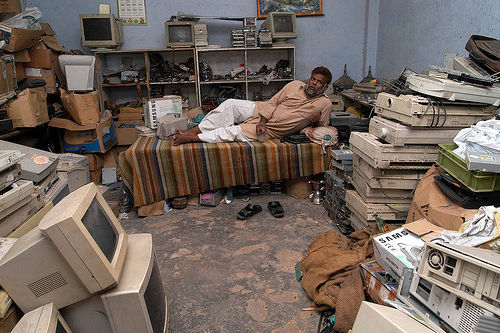
But the successful consumer society buffers its members from the material universe of consumerism. Consumers cannot be permitted to know the true costs of their consumer lifestyles for fear they would either reduce their consumption levels or demand goods manufactured to certain basic social and environmental standards. This has largely worked in the U.S. since we have been able to off-shore most of the uglier aspects of the material universe of consumerism. India is one among many of the destinations. Whether collection of our obsolete and hazardous electronic waste, destruction of the retired ships we used to transport our cheap goods, or exploitation of cheap labor to manufacture textiles, semiconductors, or other goods, Americans are largely isolated from the hazards involved in the production, distribution and disposal of our consumer goods.

Living amidst eWaste: photo by flickr member "Greenpeace India"

Can India similarly protect its privileged consumers from the harsh realities of producing, distributing, and disposing of cheap consumer goods? After all, not only are there are few places left to “off-shore” the ugly aspects of the material universe of consumerism, but most of the ugly aspects already coexist with among India’s malls, gated communities, and other trappings of developed world consumerism. If through the process of globalization Americans have managed to export not only our hazardous waste and dangerous jobs, but also our belief that in a consumer anyone who works hard has the opportunity to enjoy the fruits of her or his labor in the consumer marketplace, then maybe India can shield its full-fledged consumers from the knowledge that their consumerism sustains domestic and global inequality.

But perhaps Indians will find other motives for rejecting, or at least accepting on their own terms, American-style consumerism. Indians have always maintained a healthy suspicion of U.S. motives with respect to their country. Now should be no time to relinquish this skepticism. It may seem as if Americans want Indians, who make up a huge untapped market, to join us in our consumer lifestyles. But I doubt Americans wish for Indians to join us because we have some deep sense of compassion and justice that leads us to believe that Indians must be given access to the same quality of life as us. If we were motivated by a deep sense of compassion and justice, we’d call into question our own lifestyles, which are only sustainable to the extent that others around the world are denied some of the basic comforts—like clean drinking water—that we take for granted. Americans, or more specifically the American government, first and foremost support India’s transition to a consumer society because it is good for the American economy, not because of any concern for India’s millions of citizens living in poverty.

India: An Improvement on the Consumer Society or a Faustian Bargain?

With all this criticism, readers might be asking whether I have a solution. Suggesting an alternative approach to economic development has not been the purpose of this series, though I think a reasonable approach would combine a mix of large-scale development projects that are sensitive to local people and small-scale development projects that protect and nurture the very crafts, skills, and traditions that make India what it is today. Rather, my aim has been to point out that even if consumerism is the path India pursues, Indians should be asking some difficult questions. How will consumerism change India and Indians? Can India tailor its own uniquely Indian consumer society that avoids the pitfalls of western-style consumerism? If India embraces a patently western-style consumer society model, will it have "sold its soul" as the legendary Faust is purported to have done?

Indians don't seem to be asking these questions. Instead, what I hear many educated Indians say is this: “Sure India is changing rapidly and we have no idea what it will be like in 20 years. But we have no option, this is the only hope we have of taking care of our people.” Even if consumerism is the approach that India follows, which already seems to be the case, Indians ought to enter into it with a critical perspective that may help them avoid some of the negative outcomes, like those discussed in this series, that unquestioning American consumers now experience.

Tuesday, August 15, 2006

30 Days: “Outsourcing,” The American Perspective (Part 1 of 2)


A recent episode (2 August) of Morgan Spurlock’s “reality” TV show, 30 Days, deals with the issue of outsourcing. I was surprised to find that there has been no discussion of the episode among bloggers of Indian origin, especially desi bloggers who have access to this program unlike India-based bloggers.

In the broader blogosphere there has been a modest number of postings about 30 Days’ “Outsourcing” episode, but almost exclusively on pop culture and TV blogs (e.g., see here, here, here, and here).

Before I offer my own analysis, let me provide a bit of background on the show. Morgan Spurlock became relatively famous for his high-grossing 2004 documentary “Super Size Me” in which he attempts to subsist solely on food from the McDonald’s menu for 30 days. He followed up the success of this film with a 6-episode season of 30 Days on the Fox-owned FX cable channel. The premise of 30 Days is that in each episode a person leaves the comfort of their own lives and moves into a situation that will challenge their own beliefs and attitudes. In other words, the main character quite literally “walks a mile (or 1.6 kms) in someone else’s shoes.”

For example, last season’s episodes included a devout Christian living with Muslims, an anti-gay man living with a gay man, and Spurlock and his then-fiance abandoning their comfortable New York City lifestyle to live on minimum wage jobs in Columbus, Ohio. This season the show premiered with an anti-immigration activist living with a family of illegal immigrants in East Los Angeles, which brings us to this season’s second episode.

Here is the TVguide.com description of the episode:

Outsourcing is explored as a New York computer programmer follows his former job to Bangalore, “the Silicon Valley of India.” Chris Jobin, 37, finds he can't get it back (he'd need “Indian experience,” he's told), but he easily finds work---prestigious work---at a call center. But first Chris must take “American training.” It's “raining jobs,” Chris marvels, but the training is part of the price India must pay. “This culture,” he says, “is bending and reshaping itself to match ours.”

What is interesting about the outcome of this social experiment? First, Chris’s experience, at the very least, conveys the range of responses Americans have to outsourcing. Chris represents every American’s worst nightmare, that you will be the one whose job is sent to India. The first response most Americans have is an understandable, albeit narrowly self-interested, concern with the loss of American jobs (since one of those jobs may end being your own). One important message the episode gets across is the incongruence between concern for loss of American jobs and anger directed at Indians who are the beneficiaries of the new outsourced jobs.

A second American response to outsourcing, which is characteristic of what I will call “enlightened free market champions,” is captured by Chris’s father. At a family dinner prior to Chris’ departure for Bangalore, his father says about outsourcing: “I think it’s a good thing. I think it’s going to create a growth market and a place to sell American products and services ... If companies don’t take advantage of cheaper labor resources, then they become less competitive, they disappear, and the jobs disappear with them.”

Side note...
I find it interesting how free market advocates pull out the “let’s think about the long-term” argument when it justifies near-term impacts on workers; but they won’t consider long-term perspectives, like reducing global greenhouse gas emissions for everyone’s future benefit, when the short-term impacts are borne by corporations.

Back on point...
This seems to me to be the primary perspective, albeit largely unspoken, underlying U.S. support, substantive or in spirit, for India’s economic development. At its extreme, people use this line of reasoning to justify the loss of thousands of U.S. jobs. More significant is the way in which this perspective--that companies must remain competitive or they will go bankrupt and the jobs will be lost anyway--illustrates our reification of this thing called “the economy.” We treat the economy, and its growth, as an entity somehow independent of all the human actors who make it up. As a result we become overly focused on measuring growth quantitatively through numbers like GDP. Meanwhile, overlooked is whether or not quantitative indicators of economic growth are even correlated with qualitative measures of the improvement of the human condition.

The reification of the economy relates to the final perspective some Americans have on the outsourcing controversy. Blame, so this perspective holds, lies not with Indians working outsourced jobs, but with the corporate executives who pursue the bottom line in yet another example of the pursuit of abstract numbers, like stock prices, over real improvement in people’s quality of lives.

The “blame the executives” view is more or less the perspective Chris’s mother exhibits when she points out that executives after the almighty dollar are the real culprits of outsourcing. It is also the view expressed by a commenter to a post about the episode on the blog TV Squad: “Chris shouldn't of showed anger towards [Indians] ...its not their fault. It is the douche bag CEOs and VPs that send the work over there, they are just willing to take it...”

So, what actually transpires in Chris’s 30 days in Bangalore? He is told he cannot get a job as a programmer because he does not have enough Indian experience, but he does get a job in the call center where is host, Ravi, is a manager. Through his job at the call center and his interactions with Ravi and his family (especially Ravi’s wife, through arranged marriage, Soni), Chris comes to realize that (a) people in India needed his outsourced job a lot more than he did; and (b) that the influx of outsourced jobs, and the money they bring with them, is causing tension within Indian culture and society.

As an example of Chris’s first realization, take the following statements:
Indians have a much tougher daily life. They suffer through a lot of things that we don’t have to deal with, and they smile. Outsourcing is a step. What’s going on here is giving India a real chance to become economically viable. “

Knowing that probably like 16 people are surviving off of my one job ... it’s almost like charitable at that point. They need the job way more than I do.
As an example of his latter realization, take the tension Chris observed between Ravi and his wife, Soni. Soni fulfills her duties in the house (cooking, cleaning, and organizing the extended family’s religious rituals and cultural traditions), but she has an education and wants to test her skills in the new marketplace of jobs.

The other example of Chris’s realization that India’s economic growth is causing some internal strife occurs while he is surveying some of the damage caused during the unrest that ensued after the death of famous Kannada film actor Dr. Rajkumar. Crowds marched, often out of control, many vehicles were burned, and building windows were broken with rocks and chunks of concrete thrown by the rampagers amidst the largely peaceful gathering of mourners. Eight people were killed by police firing into the crowds.

As Chris observed:
“People were throwing rocks at the fancy new buildings. And it seemed almost like an economic outcry from the poor people of this city. There’s so much wealth around them and they’re starving ... There is millions and millions of dollars here, but there is no visible signs of it being used to take care of their own people.”
This kind of observation and analysis of the violence following Rajkumar’s death was almost completely absent from the Indian English language media (I can’t speak for how the Kannada dailies covered the violence, but perhaps a reader can inform me if the coverage was any different than the superficial stereotypes of mob violence doled out in The Hindu and Times of India).

The lone exception was a profound analysis offered by Rajendra Chenni in an editorial in The Hindu’s “Friday Review” section on April 21, in which Chenni writes:

In these times of globalisation (that is abdication of the state of its social welfare responsibilities) the state is seen as a handmaiden of the rich. In the absence of any politically mature people's movement, the anger and frustration of the deprived is ventilated in frenzied acts of destruction ... One doesn't want to make a case for the violence, but social analysis is impoverished by the blanket refusal to understand the language of violence. As long as we continue to ignore the double speak of development, modernisation and globalisation through which it privileges a few and orphans the many, there will be many occasions when the masses resort to the language of violence.

My point is that viewers should give Chris some credit for making such a connection, even just a day after the violence occurred, when few other Indians were making such a connection. Now, I am sure that many Indians would take umbrage with Chris’s attempt to link the violence following Rajkumar’s death to economic inequality and the claim that there are no visible signs of India’s increasing wealth being used to take care of its people. But events like the violence in Bangalore last April ought to give everyone pause--Indian or not. Throughout India’s economically booming metros, there seems to be a blindness to the intense poverty, perhaps facilitated by the euphoria the middle and upper classes feel about emerging economic opportunities.

“This is the only way,” they say, to put India on the global economic map and bring its people out of poverty. But by “the only way,” do these financially secure Indians mean that the only way is for India’s new wealth to be concentrated into the hands of a small number of economic elites (a social class that largely coincides with India’s historically most privileged castes)? It may such a blindness to “other ways,” and a refusal to see the growing discord among India’s most poor, that creates the type of powder keg we saw go off in Bangalore.

Now for a little self-reflection. Since returning from india back in May, I have been convinced that globalization is not good for India in the long run. It was only after watching Chris’s experience that I had the realization that globalization itself is not the concern. The creation of jobs through business process outsourcing, facilitated by India’s economic liberalization and certain external forces of globalization, is good for India. Chris learned this as well or else he would not have concluded that his job is better off in India than back in New York. My major concern has to do with the link between production and consumption as India’s economy grows.

Currently, India’s economic growth, as I have written about previously, is creating a western-style consumer class in India. But this consumer class is, for the most part, limited to those who are benefiting from India’s production-side growth (whether what is being produced is computer chips or IT services). There are certainly questions about how consumerism will transform Indian society and culture. But perhaps the more pressing question is how in-your-face consumerism will impact the masses in India for whom western-style consumption is an extremely distant dream, and one that for many will never be realized?

Maybe as Americans watch Indians embrace the consumer revolution, we can learn something about ourselves and the role of consumerism in our own lives. Chris’s 30-day experience in Bangalore certainly gave him a new way of looking at outsourcing:

I’m here talking about outsourcing to people, and about how Americans are losing their jobs and might have to sell their homes and move into an apartment. And then I look at these people and they’re getting jobs and they’re living in a prison cell, and they don’t complain. There’s a huge gap in the way people think on different ends of the planet.

But the gap that Chris is talking about is in terms of the way we think about our jobs in the global economy. In terms of our respective views on consumerism and finding happiness through material goods, there appears to be virtually no gap. Here lies my concern.

It’s a concern I will be writing about in a 5-part series I will begin shortly. Stay tuned.

Technorati tags: , , ,

The Two Indias

India’s current and potential future economic growth have been the focus of some pretty high-profile media sources lately. Stories in Time (see “India Inc.” cover story June 26, 2006), Newsweek (“The New India,” March 6, 2006 cover story), and even The Economist (“Can India Fly?” June 3, 2006), might lead one to believe that India’s masses are finally being lifted by the rising tide.

In the Indian blogosphere, there is much debate about whether the optimism of these stories is warranted. Here’s how the basic argument plays out: the optimists contend that market liberalization is working, but poverty eradication in India will take some time, and besides this is "The Only Way" that India can possibly hope to take care of its more than 1 billion people. Those more cynical about market liberalization’s current and future impacts on poverty--let’s call them the pessimists--argue that there may be some minor signs of poverty alleviation, but that there are still far too many Indians living in absolute abject poverty, and that the vast majority of India’s growing economic wealth is being concentrated in the hands of the elite.

Here’s an example of the optimist view:
“Poverty in India is real. It's pathetic. But it has been reduced Not by revolution (which never really benefit the poor, now, do they?). But by market reforms.

This sucks less than any other darn alternative out there.

And, this side of the Kingdom, in an imperfect, fallen world, where we don't have a magic wand to suddenly turn everyone into a saint, it's the only way there, I'm convinced more and more. [from a blogger’s post titled “India Shining: II.”]

The pessimists focus primarily on the problems of concentration of wealth, inequality, and a growing rural/urban divide, as illustrated in the following excerpts:
...somehow I believe that there are two India’s and never the ‘twain shall meet ... The ‘twain should meet, because only when you see what is happening, one might realize that the optimism on the surface ... is matched by a level of despondency at the bottom. [from “India A and B” on the blog Don’t Trust the Indian Media!]
“The new wealthy in India are quietly abandoning the state: paying for their own private police force and playing golf at private clubs. There appears to be little concern about supporting public services or about the poor who are stuck with decrepit hospitals and schools.” [from “A Tale of Two Indias,” A Guardian special report]
The pessimists go on to argue that the “India is Shining” viewpoint is largely held by the 12% or so of Indians who are currently benefiting from the country’s economic growth. The optimists claim that the country’s growth has already reduced poverty, and that the pessimists are unpatriotic socialists who’d rather see India stay at the 3-4% rate of growth of the 1980s.

Obviously there is a lot of enmity between the holders of these two views. In future entries, I intend to unpack both arguments and get beyond the “Has economic liberalization been good for India?” debate. After all, whether it has been good depends a lot on what India’s economic and social goals are.

Technorati tags: , ,