Showing posts with label American society. Show all posts

Friday, January 05, 2007

The Zavelogue's Final Entry

I had a lot of mixed emotions upon returning to the U.S. In this final entry from the India Zavelogue I explain some of the feelings and the origins of The Curious Stall:

It's been more than a month since my last entry. Although we've been busy, the real excuse for failing to bring the Zavelogue to the type of dignified closing that I think it deserves has to do with all of the very mixed emotions I have been having.

We were in Seattle last week for my cousin's wedding. My mother rented a house for the week, and we stayed there with her and my sister's family. It was the first time in a long while, probably ever, that we all got to spend so much time together. I had a good time, but I guess outwardly I seemed troubled. My sister thought I seemed very depressed and suggested I try medication. Her dismay with my behavior caused me to think about what I was feeling.

I think I can narrow down my emotions to two related factors: (1) our re-assimilation happened too quickly and left me without an opportunity to transition between what we experienced in India and what we were returning to in the U.S.; (2) in the six weeks since we've been back, few people with whom we've interacted have expressed any real genuine interest in what our experience was like.

First, here are some pictures to illustrate the three types of environments through which we transitioned:


India: Lots of cows and blazing hot

Switzerland: Lake Geneva and the Alps

San Francisco: Fog and the Golden Gate Bridge

Re-assimilation

I can't say what would have been the most appropriate way to make the transition back to life in the U.S. I'm pretty sure, though, that hopping from India to a week in Switzerland was not the best way. India ranks near the bottom in most measures of GDP, health, and literacy. Switzerland ranks near the top. Perhaps the best approach would have been to return directly to our home. We certainly enjoyed getting to see our respective families in Maryland and Seattle, but those weeks were tough knowing that the journey was over on one hand, but also that we were not yet really home.

Then there was the--for lack of a better word I'll risk sounding cliche--culture shock upon returning to the U.S. This was a little different than the shock of jumping from India to Switzerland. Switzerland is a wealthy, and therefore expensive, place. Switzerland is all about quality of life. But the wealth of the U.S. manifests itself differently. In the U.S., we know we are a wealthy society because of the amount of stuff we consume, not because we have a high quality of life. In fact, despite our levels of consumption, we do not have a high quality of life. For example, despite our wealth, Americans tend to be less healthy, on average, than our counterparts in other parts of the developed world.

My point is that American consumerism made the transition tough. For the six months we were in India, I felt virtually no compulsion to consume. That's not to say that I didn't consume. It goes without saying that to exist one must consume. In fact, we consumed more than the basics. And while in India we certainly consumed far more than the average Indian, even if you exclude all the gifts and items we bought to bring back with us.

What I mean when I say I felt no compulsion to consume is that I was not exposed to the types of goods, nor advertisements for such goods, that gave me a "I'd really like to have that" feeling. As much as I'm a critic of American consumerism, I am implicated just the same. That's precisely my point. Living in the U.S. without being sucked into the practice of justifying extravagant purchases as somehow "essential needs" and not whimsical "wants" requires a herculean effort.

For six months I never visited a shopping website. And though we spent a fair amount of time in shopping malls, where the only decent children's play areas could be found, I never bought anything for myself except a book or two. Yet within two days of returning, even without having watched a minute of television, I found myself wanting. Do I need a new computer? Absolutely not. But Apple has some really nice new iMacs and laptops. My consumer mind begins trying to convince my rational mind that I do need a new computer. After all, my PowerBook got pretty banged up while in India and the nearly full hard drive seems to slow down basic tasks.

I don't recall having gone through that sort of internal dialogue while in India. Yet it's precisely such a dialogue, and one in which the consumer mind wins the debate, that is crucial to a thriving consumer society.

Interacting with others
Returning has also been difficult because in some unidentifiable way I feel like the experience in India has changed me, and yet I don't know how to communicate this change to others, nor do others ask me anything other than superficial questions about the experience. I write some of this off to the fact that I explained in fairly great detail what the experience was like right here in the Zavelogue. I can imagine that regular readers don't have a lot of questions about what the experience was like. That's probably why, in some cases, people we've seen for the first time in six months greet us as if we've just returned from a weekend trip to Santa Barbara. Part of what I am trying to explain here is the strangeness of feeling like we just slipped right back into our lives without missing a beat. One source of my anomie comes from not wanting to feel that way.

As for interacting with strangers, it's as if I want there to be a big sign over my head saying "Hey! I've been in India the last six months!" It's not that I want any special attention. I would like for people to know that the experience changed me, but this information may be irrelevant to a stranger. It's more that I feel like I have some insights that are interesting, if not also helpful for understanding some of the global changes happening as a result of globalization.

This is why I have to get going on my book. But I also want to get ideas out there right away, which is why I am closing down the Zavelogue and launching a new blog called The Curious Stall. Postings will be much less frequent, less personal, and a tad bit more intellectual. Read the first entry to find out why it is called The Curious Stall.

The Curious Stall will be a way, in the short run, for me to continue working out some of the feelings I discussed above. But I also want it to be a place where a much wider audience engages ideas about the changes through which India as a nation is going, and what these changes mean for its people, other people around the world, and our understanding of ourselves.

With that, I promise not to recycle any more content from the Zavelogue. I've got a pile of topics I want to write about in The Curious Stall. From here on out, expect more original content, and hopefully, more frequent content.

Technorati tags: , ,

Reverse Culture Shock

I thought some of the Indian readers of The Curious Stall might enjoy reading about our observations when we returned to the U.S. after six months in India. The following is taken almost word-for-word from my entry in the India Zavelogue on May 29, 2006 (follow the link in the title of this entry to see the original).

We landed back on U.S. soil on Saturday at about 12:30 p.m. Eastern Daylight time. Even though there were mostly Americans on the flight, it was strange walking through the terminal and being in the presence of so many Americans again. Americans, on average, tend to be somewhat larger than Europeans, and orders of magnitude larger than Indians.

I've heard some debates recently about whether there really is an "obesity epidemic" in the U.S. Just spend some time away from the U.S. and then, upon returning, plop yourself right down in middle America. I think this would resolve any disagreements.

I'm sorry the first observation back in the U.S. has to be such a negative one. But it was hard not to notice.

On a more positive note, our return went smoothly and despite our initial observations we are quite pleased to be back. In a matter of 24 hours, we managed to acquaint ourselves with two quintessentially American activities...driving a minivan and shopping at Wal-Mart [Note: for readers in India who might not know about Wal-Mart stores, just wait and soon enough you'll have them in India]. We had to rent a minivan at the airport to accommodate all of our luggage.

Then, once in Easton, on Maryland's rural Eastern Shore where my in-laws/Marion's parents live, we needed some basic supplies. Easton is probably like many towns in the U.S. It has a Wal-Mart and very few other options for basic shopping (this is just one of the many reasons more and more Americans are learning to dislike Wal-Mart). So we went to Wal-Mart for diapers, deodorant, razor blades, and a new sippy cup for Luc who has been off the bottle for about ten days now. Unlike typical Americans, we actually made it out of Wal-Mart with little more than we actually needed.

After that we went to a supermarket to get some basic provisions. I think Claire (my 3-year old daughter) was a little overwhelmed at all of the options. She kept grabbing things off of shelves and throwing minor fits when we told her she could not have them.

All in all, Claire and Luc (2-year old son) seem quite happy to be back. A big box with gifts from my mother was waiting for them. Then there were more gifts from Marion's mother. But mostly I think they just enjoy, for the first time in six months, having a lot of space to explore without us having to worry about their safety. We've been in hotel rooms for over a month, and there's just no room to get space from one another. In the huge house we're in they can escape not only from us, but also from each other. Last night, after baths, when I tried to sit down with Luc next to Claire and her Grandear (what she calls Marion's mom), Claire said, "No, don't sit down, I just want some peaceful time with Grandear."

Other signs of cultural adjustment ... Luc is calling the horses at Uncle John's "cows." Maybe he saw too many cows in India and now thinks all large, four-legged, hoofed animals are cows. He also had an odd reaction to Splash, the black lab of the house. He kind of screamed, not really in a scared way, but in a startled way. We saw plenty of dogs in India, but mostly insisted that the children stay clear of them. Then this morning when Splash went on a walk with us, Luc seemed to be fine, and even excited to have Splash along.

Neither Marion nor I have felt very reflective, so at this point we don't have any great revelations to share about how our experience has changed us, or what we think about India (or the U.S., for that matter), now that we're back. Mostly we just feel a sense of relief and exhaustion. Marion also feels like she has a drill pressed to her head. She's had another migraine more or less since we left Geneva.

Just the other day, a little more than six months after writing the above, I completed the final report that I owed the Fulbright Program, which had sponsored my research in India. Given the additional time that elapsed, I was able to reflect a little more meaningfully on the experience. In it, I wrote "It's actually quite difficult to explain to people here in the U.S. what India is like. Most descriptions make it sound like a place you wouldn't want to travel to, much less live in. What I have tried to communicate is the beauty of the people and the spirit and energy of the place, both of which are all the more palpable precisely because India can be such a loud, dirty, and in-your-face kind of place."

Next I'll post one more entry from the India Zavelogue. It will be the last entry that appeared. Shortly thereafter I began The Curious Stall. Stay tuned...


Technorati tags: , ,

Tuesday, November 28, 2006

Indian "Heroes" on American TV

I know in the past there have been a few discussions in the Indian blogosphere about desis appearing on American television programs. For example, there was the desi couple that was one of the first two teams to get booted from this season's "Amazing Race." I don't watch much MTV these days, but a student told me about a couple of desis on an MTV show called "My Super Sweet 16" where rich girls' parents spoil them on their 16th birthdays. So I looked into it, and sure enough, in episode 25 there were Priya and Divya. The summary of the episode begins like this:

Texas has two princesses when 15 year old Priya and 18 year old sister, Divya, throw a bash for a birthday and graduation. As one of the richest families in the city, the two only want the most extravagant World Indian-themed party there is.

For another take on Priya and Divya (and an account of a more modest sweet 16 birthday, see this archived post at Sepia Mutiny).


My real point in this frivolous post (I'll get back to more serious topics in the coming days) is that there is a hugely popular show this television season the entire premise of which is based on a professor of genetics from Chennai who begins tracking down "ordinary people who ... possess extraordinary abilities" (from the show's tag line). Of course, these people with extraordinary abilities (e.g., teleportation, spontaneous self-healing, flight, etc.) are all Americans. But Mohinder, the Indian character's name (played by Sendhil Ramamurthy), returns to Chennai in later episodes after momentarily giving up on figuring out the mystery of his father's death (it was his father who first hypothesized that evolution has produced people with special abilities).

Now, this is no low-budget TV show. It's on NBC, in a primetime slot, and has proven to be a big hit. Yet it seems as if the producers have cut all the corners possible in shooting the scenes that are supposed to be in India.

In the scene below, from the pilot episode, you can get a sense of what I mean:

(Sorry, I'm having trouble embedding YouTube video in Blogger beta. For now, here's the link.)

Be sure to watch at least a couple minutes in, until you get to the part where Mohinder is lecturing to students, presumably at the University of Madras. Then keep watching to see the scene where Mohinder walks through a supposed monsoon rain.

In later episodes there are quaint shots of Mohinder in a "bustling" Chennai market. I put bustling in quotes because the market in the scene bustles nothing at all like a real Indian market. Sure, the show probably didn't have the budget to go and shoot in India, but they could have gotten some better consultants to help them re-create some more believable Chennai-like scenes.


Technorati tags: , ,

Tuesday, September 12, 2006

Consumerism in India: A Faustian Bargain? (Part 5 of 5)

The Bigger Picture

Before bringing this series to a close, I want to place India’s move towards a consumer society in a larger framework. India, after all, represents a microcosm of the larger globalizing world. For within India exists the same tension permeating global society. The tension is between those individuals who have benefited from economic liberalization and who have become full-fledged citizens in the consumer society, and those individuals who struggle to provide for themselves and their families the basic essentials for survival, reaping little or no benefits of economic liberalization or the consumer society.

Let me elaborate on this tension by examining the way in which the current global arrangement allows citizens of the developed world to deny any personal responsibility for the consequences of consumption. In fact, not only do we deny any responsibility for the ways in which our consumer lifestyles lead to global problems like climate change or local problems like sick workers or communities contaminated by industrial wastes, we go so far as to propose that the solution to the problems of the developing world is even more consumerism.

To function, a consumer society depends on consumer blindness to the broader social, cultural, and environmental consequences of our marketplace decisions. American-style consumerism has done very well at keeping the American consumer from understanding the nature of the damage done by the production and distribution of our cheap goods. As a result, Americans think it makes perfect sense that we have a right to our big SUVs, to our cheap disposable goods, and to our cheap out-of-season produce shipped to us from around the world. We work hard, so the argument goes, these things are available to us in the marketplace, and therefore we have a right to spend our hard-earned money on them if we so desire.

photo by flickr member "jennie"

How do Americans fail to make connections between our consumer choices and matters of social justice for people elsewhere around the world? After all, we make connections between heroine or bootlegged DVDs and terrorism, and define it as our moral duty to abstain from purchasing any products that might aid terrorist activities. We also make the determination for others that the production and consumption of pornography, tobacco, alcohol, and drugs, can be dangerous for certain members of society. So we regulate the production and distribution of such goods and services. Yet we don't regulate our own companies when they operate overseas in ways that would clearly be in violation of U.S. standards, and we certainly don’t regulate our own consumer behavior even though our decisions in the marketplace may perpetuate global systems of injustice.

The U.S. grew economically wealthy as a country during the last half of the 19th and the first half of the 20th century. This growth was a result of visionary leaders, innovative entrepreneurs, and hard-working immigrants who came in search of the American dream. Many of them achieved it. But in the mid-20th century, when it began to become apparent that some of our growth was made possible through various forms of internal exploitation (e.g. child labor, the labor of illegal immigrants, and other forms of exploitation of labor, as well as through exploitation of the environment in the form of pollution for which corporations did not have to pay), we passed laws to put constraints on these forms of exploitation. Corporations determined that they could escape these constraints by moving to other parts of the world where, because of range of factors, regulations were either non-existent or unenforced and industry in any form was welcomed.

Today, these same corporations are able to provide Americans, as well as other developed societies, with the cheap goods to which we believe we have a right. At one time, Americans could make purchases in the marketplace and be somewhat assured—because most everything we purchased was made in the U.S. and therefore met American labor, environmental, and human rights standards—that our purchases were not harming people or the environments on which people depend for their livelihood. Today we live in a global marketplace and therefore do not have the luxury of being so presumptuous.

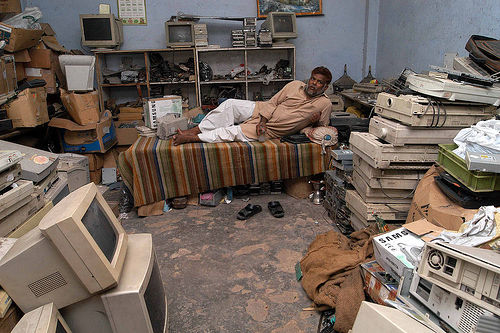
But the successful consumer society buffers its members from the material universe of consumerism. Consumers cannot be permitted to know the true costs of their consumer lifestyles for fear they would either reduce their consumption levels or demand goods manufactured to certain basic social and environmental standards. This has largely worked in the U.S. since we have been able to off-shore most of the uglier aspects of the material universe of consumerism. India is one among many of the destinations. Whether collection of our obsolete and hazardous electronic waste, destruction of the retired ships we used to transport our cheap goods, or exploitation of cheap labor to manufacture textiles, semiconductors, or other goods, Americans are largely isolated from the hazards involved in the production, distribution and disposal of our consumer goods.

Living amidst eWaste: photo by flickr member "Greenpeace India"

Can India similarly protect its privileged consumers from the harsh realities of producing, distributing, and disposing of cheap consumer goods? After all, not only are there are few places left to “off-shore” the ugly aspects of the material universe of consumerism, but most of the ugly aspects already coexist with among India’s malls, gated communities, and other trappings of developed world consumerism. If through the process of globalization Americans have managed to export not only our hazardous waste and dangerous jobs, but also our belief that in a consumer anyone who works hard has the opportunity to enjoy the fruits of her or his labor in the consumer marketplace, then maybe India can shield its full-fledged consumers from the knowledge that their consumerism sustains domestic and global inequality.

But perhaps Indians will find other motives for rejecting, or at least accepting on their own terms, American-style consumerism. Indians have always maintained a healthy suspicion of U.S. motives with respect to their country. Now should be no time to relinquish this skepticism. It may seem as if Americans want Indians, who make up a huge untapped market, to join us in our consumer lifestyles. But I doubt Americans wish for Indians to join us because we have some deep sense of compassion and justice that leads us to believe that Indians must be given access to the same quality of life as us. If we were motivated by a deep sense of compassion and justice, we’d call into question our own lifestyles, which are only sustainable to the extent that others around the world are denied some of the basic comforts—like clean drinking water—that we take for granted. Americans, or more specifically the American government, first and foremost support India’s transition to a consumer society because it is good for the American economy, not because of any concern for India’s millions of citizens living in poverty.

India: An Improvement on the Consumer Society or a Faustian Bargain?

With all this criticism, readers might be asking whether I have a solution. Suggesting an alternative approach to economic development has not been the purpose of this series, though I think a reasonable approach would combine a mix of large-scale development projects that are sensitive to local people and small-scale development projects that protect and nurture the very crafts, skills, and traditions that make India what it is today. Rather, my aim has been to point out that even if consumerism is the path India pursues, Indians should be asking some difficult questions. How will consumerism change India and Indians? Can India tailor its own uniquely Indian consumer society that avoids the pitfalls of western-style consumerism? If India embraces a patently western-style consumer society model, will it have "sold its soul" as the legendary Faust is purported to have done?

Indians don't seem to be asking these questions. Instead, what I hear many educated Indians say is this: “Sure India is changing rapidly and we have no idea what it will be like in 20 years. But we have no option, this is the only hope we have of taking care of our people.” Even if consumerism is the approach that India follows, which already seems to be the case, Indians ought to enter into it with a critical perspective that may help them avoid some of the negative outcomes, like those discussed in this series, that unquestioning American consumers now experience.

Tuesday, August 15, 2006

In HyperCity, India Gets Big Box Retail


For better or worse, big box retail has arrived in India. Yet another sign of the dramatic changes India is undergoing.

Back in April, K. Raheja Corp. Group, a real estate and retailing giant in India, opened a 120,000 square foot HyperCity retail store in Malad, a Mumbai suburb already known for another K. Raheja Corp. project, the Inorbit Mall. The company plans to open somewhere between 35 and 50 more HyperCities throughout India's tier-I (e.g., Delhi, Bangalore, Chennai) and tier-II (e.g., Mangalore, Aurangabad, Lucknow) cities in the next ten years.

How much does this emerging market for big-box retail in India really represent a changing India? After all, only a very small percentage of India's population can afford to shop at a place like HyperCity. Nearly half of Mumbai's population, almost 6 million people, live in slums like
Dharavi--ignominiously known as Asia's largest slum--and aren't likely to make it to the suburb of Malad, a good hour away by car or train. But poverty is meaningless when people embrace consumer debt. HyperCity seems to be anticipating a growth in the acceptance of consumer debt more than any sort of real economic prosperity among the country's poor. This may sound cynical, but when you learn that HyperCity has partnered with Hong Kong bank and Citi Financial to make sure rupee-less consumers can still make a purchase, it sounds more like the reality:

"It's our way of telling shoppers--if you don't have money to pay for something now, don't fret," according to HyperCity's South African CEO, Andrew Levermore, in an interview on
rediff.com.

Until very recently, this sort of consumer debt was unheard of in India. Levermore also has his eye on other ways in which the Indian consumer is changing:

"We have a phrase here: 'It won't work in India - IWWII,' " Levermore recently explained in an article in The Guardian

"I was told Indian housewives want to handle their vegetables. They don't. They like it just like everywhere else: clean, wrapped in cellophane and free from everyone else's grubby fingers."

Let's return to the question: How much does a place like HyperCity really change a country of more than a billion people, especially when 97% of all retail spending in the country--a total of $258 billion--happens in traditional family-run shops taking up, on average, about 500 square feet of space? (statistics are from The Guardian article cited above).


If HyperCity proves to be anything like Wal-Mart, it has the potential to lead to vast change.

A small aside...
Admittedly, there is ongoing debate about the precise impacts Wal-Mart has on small businesses, rural communities, global supply chains, and workers and working conditions. But even if, on balance, there is a net "good," the fact that there is such opposition to Wal-Mart in the U.S., as evidenced not least of which by the many small towns fighting legal battles to keep Wal-Mart out of their communities, says something about perceived impacts.

Back on point...
If even a small fraction of the people working in India's current mom-and-pop retail sector wind up out of business, The 340 or so jobs created by each HyperCity will hardly balance the losses.

Of greater concern may be the way HyperCity is following the American big box model of suburban development. This is where land is cheapest, so obviously HyperCities, which are land-intensive enterprises, will be located in suburban areas. But unlike some of the uncertainties surrounding social impacts of Wal-Marts, the environmental impacts of Wal-Mart-style development are fairly well documented (for a conservative government view, see NASA's website on the use of satellite images to understand sprawl's environmental impacts; or Sierra Club's website for a good article on the link between big box sprawl and climate changing CO2 emissions).

But maybe the HyperCities of India, and other retailing magnates hoping to follow in HyperCitiy's footsteps, understand the social and environmental impacts their operations will have. This is what K. Raheja Corp. says about its commitment to social responsibility:

...increasing urbanisation leading to spiralling prices of real estate and higher pollution levels have necessitated the need to provide more green cover. At K. Raheja Corp, we identified this need and developed parks, children's play areas, beautiful traffic islands and similar facilities to do our bit towards creating a more equitable environment.

American companies who have made promises of social or environmental responsibility haven't always delivered on their promises (though what Wal-Mart does with its new image makeover, which includes a commitment to a sweeping environmental initiative, will be interesting). In the case of the K. Raheja Corp., I'm not sure that adding a little green cover is going to balance the impacts its development projects have. But I'd like to move away from the environmental impact argument anyway. It's too easy for critics to dismiss arguments coming from the west that the global south should reduce its environmental impacts to help save the world from the consequences of climate change.

Instead, let me conclude by suggesting that India should move ahead not just with HyperCities throughout India, but also with the opening up of foreign direct investment for retailers like Wal-Mart, Target, Home Depot, and Best Buy. I say this partly tongue-in-cheek. But in all seriousness, this seems to be the inevitable end toward which India is headed. Furthermore, real competition might mean that the company with the retail model that is most consistent with current Indian preferences and values will win out. Carrefour and Wal-Mart both learned following their failures in South Korea that a successful retail model in one part of the world doesn't always translate to another part.

Regardless of how the big box retail revolution in India proceeds, I would hope that Indians are able, in a way that Americans could only do after the fact, to anticipate and respond to the changes big box retail will bring: from the weakened social networks resulting from the vanquishing of local retailing and the increased time spent in automobiles to reach the new mega retailing outlets, to the increased individualism and diminished communitarianism resulting from the heightened focus on self-image and the pursuit of happiness through material goods that comes with the type of consumer capitalism epitomized by big box retail.

If, in fact, big box retailing proceeds in India in a way that is sensitive to local customs and values (here's where I become highly skeptical of my own hopes), then perhaps Levermore, the HyperCity CEO, will be right when he claims that "HyperCITY exemplifies all that India should be proud of," (from an article in The Telegraph.)

Technorati tags: ,